

The officer reads it aloud
In October I spent an afternoon aboard the Intrepid, the aircraft carrier docked at Pier 86 in Manhattan, between sessions of an AI engineering conference. A docent walked me through how the ship launched a plane.
Before a pilot ever touches the aircraft, a sailor called the plane captain has already gone over it end to end. The plane is his responsibility whenever it is not in the air. Then the plane taxis to the catapult, and an officer standing on the flight deck reads the pilot a checklist out loud. Check your flaps. Check your ailerons. Check your rudder. Check the engine. Check your hydraulics. The pilot answers item by item. If anything does not check, the plane comes off the flight line and goes below for repair. Two thumbs up, one from the pilot and one from the officer, and a crewman fires the catapult.

Intrepid’s flight deck. One of the two most dangerous places on the ship.
Three thousand people ran that ship. About five hundred of them worked the flight deck, one of the two most dangerous places aboard. I asked the docent whether anyone wrote these procedures before the accidents or after.
“A lot of these rules were written in blood,” he said.
Written in blood
He told me about the Lexington. On May 8, 1942, in the Coral Sea, Japanese torpedoes ruptured her aviation fuel tanks. The crew fought the fires, brought them under control, and resumed flight operations. About an hour later, electrical sparks found the gasoline vapor spreading from the ruptured tanks. The explosions came in chains after that, and by evening the Navy scuttled her.
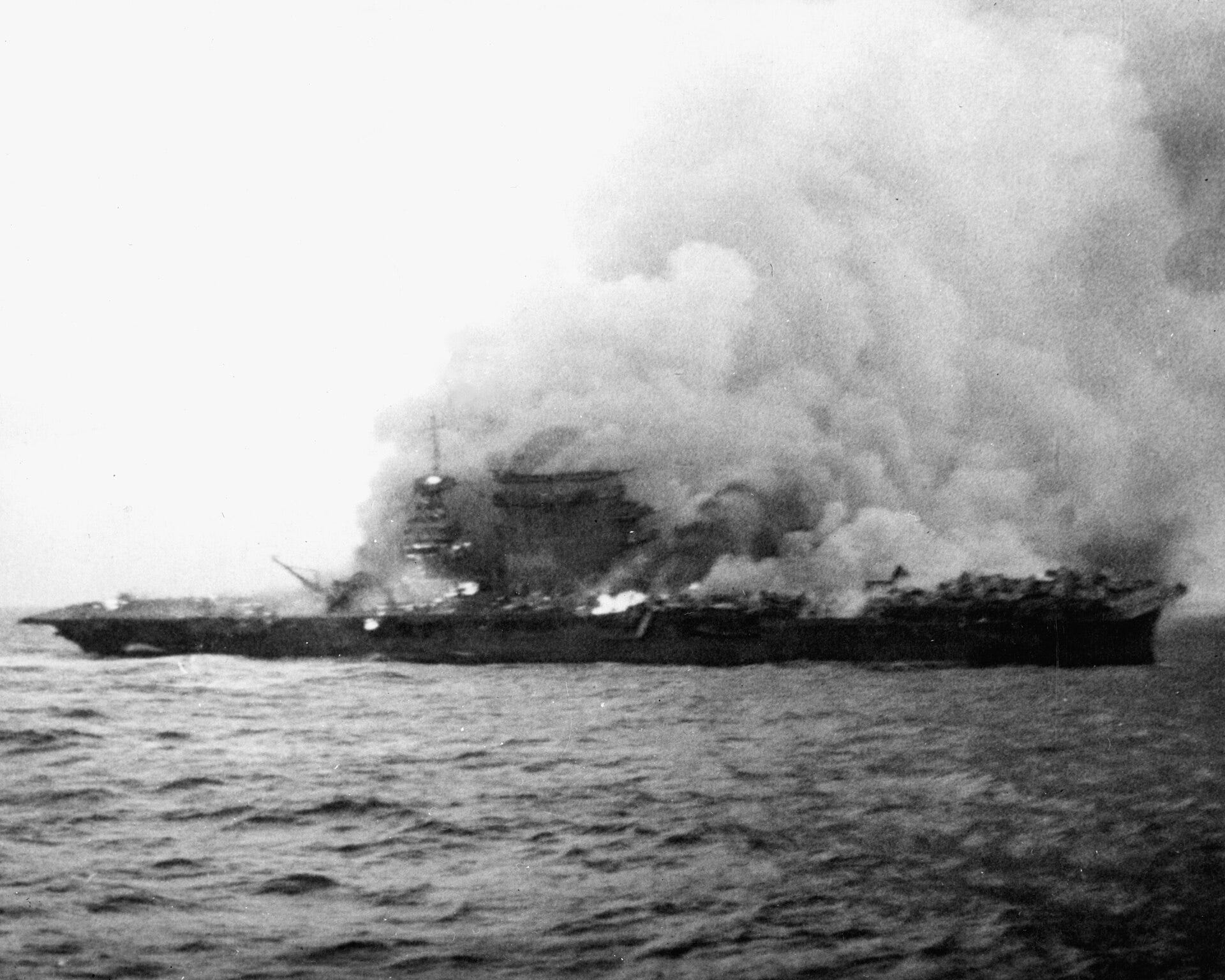
USS Lexington, May 8, 1942. The fires were under control for about an hour. Official U.S. Navy photograph.
The lesson moved at war speed. A month later at Midway, the Yorktown’s crew drained her aviation fuel lines and filled them with inert carbon dioxide before the battle. By the time Intrepid entered service a year after Coral Sea, purging the gas lines was simply how a carrier prepared to be hit. Nobody designed that rule at a desk. It crystallized around a wreck, and you can still read the disaster back out of the procedure.
Most of the protocols we trust have this shape. In October 1935 the prototype of the B-17 crashed on takeoff at Wright Field because two of the most experienced test pilots in the country forgot to release the gust locks. The investigation’s conclusion was that the plane was too complex for any one man’s memory, and the fix was a piece of paper: the pilot’s checklist. In March 1977 two 747s collided on a foggy runway in Tenerife, 583 dead, because a captain heard a route clearance and believed it was a takeoff clearance. The phraseology hardened afterward; today the word “takeoff” is spoken only in the clearance itself. In the 1960s, NASA and Pillsbury had to make food for astronauts and could not test their way to safety, because the tests destroy the food. So they typed the production process instead, as critical control points, and the system became HACCP. Enron collapsed in December 2001; Sarbanes-Oxley was law by the following July. Double entry bookkeeping is the slow one, centuries of merchant disputes condensed into the rule that every entry must have a counterpart.
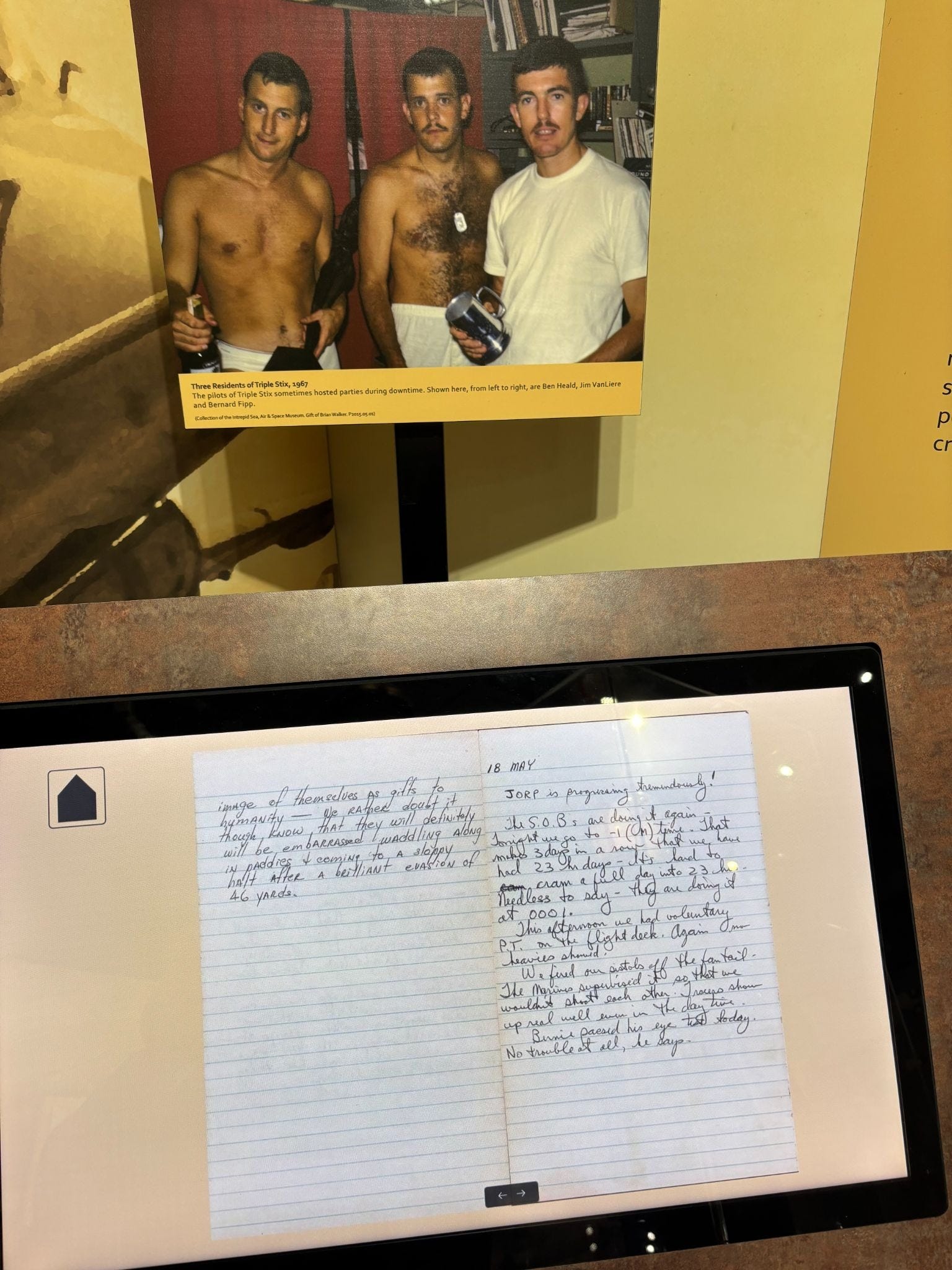
From the Triple Stix pilots’ log, 1967. Natural language at sea: jokes, complaints, poetry.
Seth Stafford, chief scientist at a clinical AI company and one of the first readers of my admissibility essay, gave me the general law in two lines. Natural language is very weakly typed; every word is allowed to be ambiguous. We relish that in poetry, and technical fields banish it by inventing strongly typed protocols. “When the stakes are high,” he wrote, “people transition from weakly to strongly typed language.” Air traffic control is the specimen he reached for: altitudes in digits, every instruction read back word for word, a grammar so rigid that a misheard syllable has nowhere to hide.
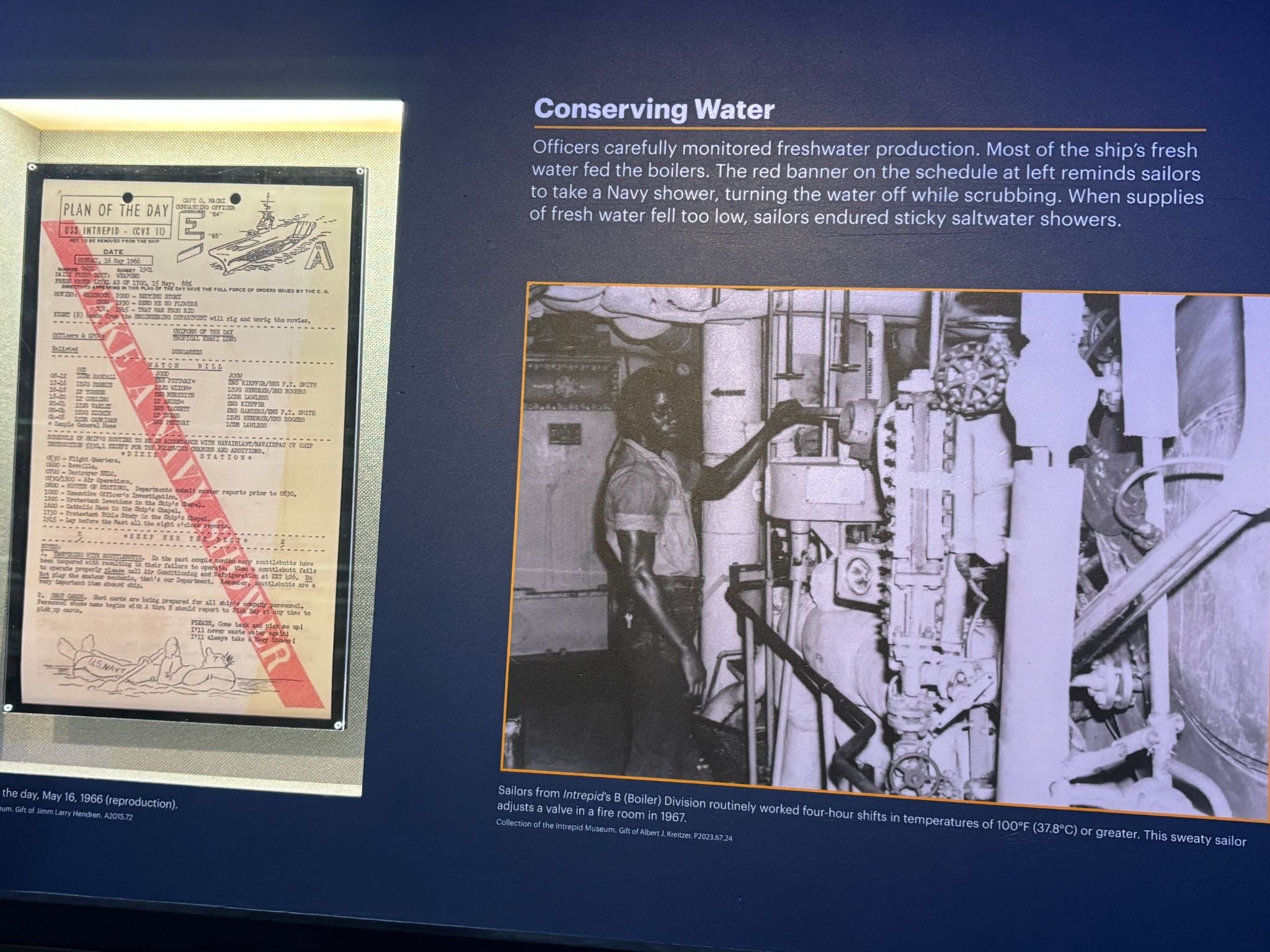
The same ship, strongly typed: Plan of the Day, May 16, 1966. Watch bill, schedule, uniform of the day.
The fossils still forming
Crystallization did not stop in the last century. In my last essay I wrote about a restaurant company that pays seven figures a year for photographs proving its milk was at temperature, which is HACCP’s descendant living in a phone camera. Harvey hand built 75,000 acceptance criteria to define what acceptable legal work means. Both are protocols in the larval stage, typed rules growing around work that used to run on trust.
In New York I watched a mature protocol get ported to agents on purpose. A session on decision assurance opened with a line I have been repeating since: in audit, the opinion is the product, and the opinion is only as good as the basis behind it. The speaker walked through a bank reconciliation agent. Good evals, happy users, shipped. Then the scenario everyone in a regulated industry recognizes: the audit gets selected for inspection, and someone asks, for this specific procedure, on this specific piece of evidence, how did you arrive at this position? I don’t care what your evals say. The audit profession crystallized its answer long ago. An experienced auditor who has not done the work should be able to follow the tests performed, the evidence collected, and the decision reached. The speaker’s whole proposal was to hold agents to the auditor’s standard, controls and all, down to knowing when the agent must stop and a human must decide.
The disasters behind that standard have names. Peregrine Financial’s founder forged paper bank statements for nearly twenty years while audits passed. What ended it was a typed protocol: the regulator switched to confirming balances electronically with the bank, and the forgeries had nowhere left to live.
The oldest fossil in this essay is growing a new layer right now, inside my own portfolio. My newest investment, Talky, automates enterprise accounting, the domain where double entry crystallized seven centuries ago. The checks its agents answer to were derived from expert accountants reviewing and correcting the system’s work, judgment condensing into a typed harness one correction at a time. The discipline that invented the counterpart rule on paper is now compiling its judgment into machine checkable form, and I get to watch it happen from the cap table.
Decades into quarters
The same transition is running in software right now, in public. A survey presented in New York found that at large companies, one in five teams takes five months to get an agent into production, against hours or days everywhere else. The presenter’s read: the five months go into approvals and audit trails, which is bureaucracy doing exactly what it was fossilized to do.
At a coding agents summit in San Francisco this month, I watched the code review protocol crystallize on stage. A platform engineer showed his team’s pull requests, which no longer open on a diff. They open on typed sections: intent, acceptance criteria, invariants, decisions, evidence. His words for the shift: “we have changed our surface from being the diff to reviewing the evidence.” Review time fell from five days to under three hours, and he claims better auditability than the human process ever had, because the evidence is captured instead of implied. At the same summit, another team took 33 production incidents, extracted the changes that caused and fixed each one, and compiled them into review rules, then measured which incidents the rules would have prevented. That is the Lexington loop, incident to postmortem to rule, running in weeks instead of wars.
Even git is yielding. In October, Anthropic published how merges to its monorepo grew from about 2,500 a day in May to more than 30,000 by September, most of it agent written, until git could not keep up; seven engineers built a replacement and moved the monorepo off git in five months. Version control is itself a crystallized protocol, the fossil of two decades of collaboration pain. It is being re-fossilized under agent volume, on a published schedule: the same class of problems is expected to become commonplace within six to twelve months. Version control is itself a crystallized protocol, the fossil of two decades of collaboration pain. It is being re-fossilized under agent volume, on a published schedule: the same class of problems is expected to reach everyone within six to twelve months.
The ratchet has a twist. An engineer who spent a year stripping guardrails out of a coding tool as the models improved told the New York audience that in his new product he is writing guardrails again, because the agents entered unfamiliar domains. Every new territory starts out weakly typed and pays its way into protocol. The Navy compressed decades of safety learning into a month because the war left no choice. Agent teams are compressing it into quarters because the volume leaves no choice.
A fifth of the rules are naked
This month I ran a question on X for 48 hours: how do engineering teams running multiple coding agents handle decisions made across people, sessions, and tools? Roughly sixty engineers answered, from solo developers to people at Disney and Amazon.
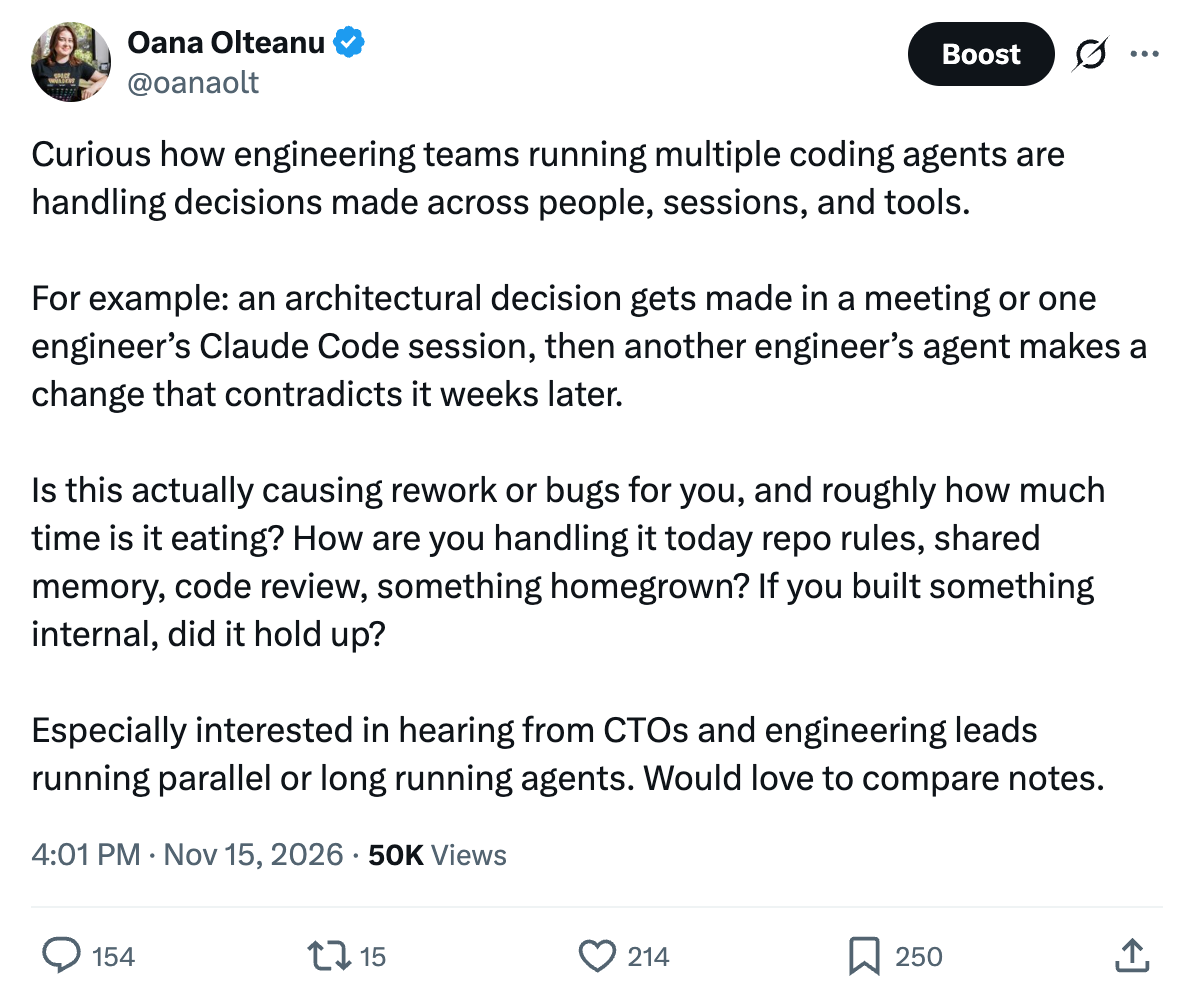
The post. Roughly sixty engineers answered in 48 hours.
The answers were the thesis in miniature. Everyone has capture: decisions recorded in markdown, tickets, decision logs. Binding is another matter. One team counted. Of their 95 architecture decision records, about 5 percent had been compiled into lint rules, about 55 percent were pinned by a unit test naming the decision, and 40 percent existed as prose only, with a third of the prose set enforced by a schema anyway. The truly naked residual is about a fifth of all decisions, and it has a character: boundary crossing rules that, in one respondent’s words, “can’t be asserted from inside this repo.” Artifacts bind in proportion to the machinery behind them. A schema binds harder than a test, and anything binds harder than prose.
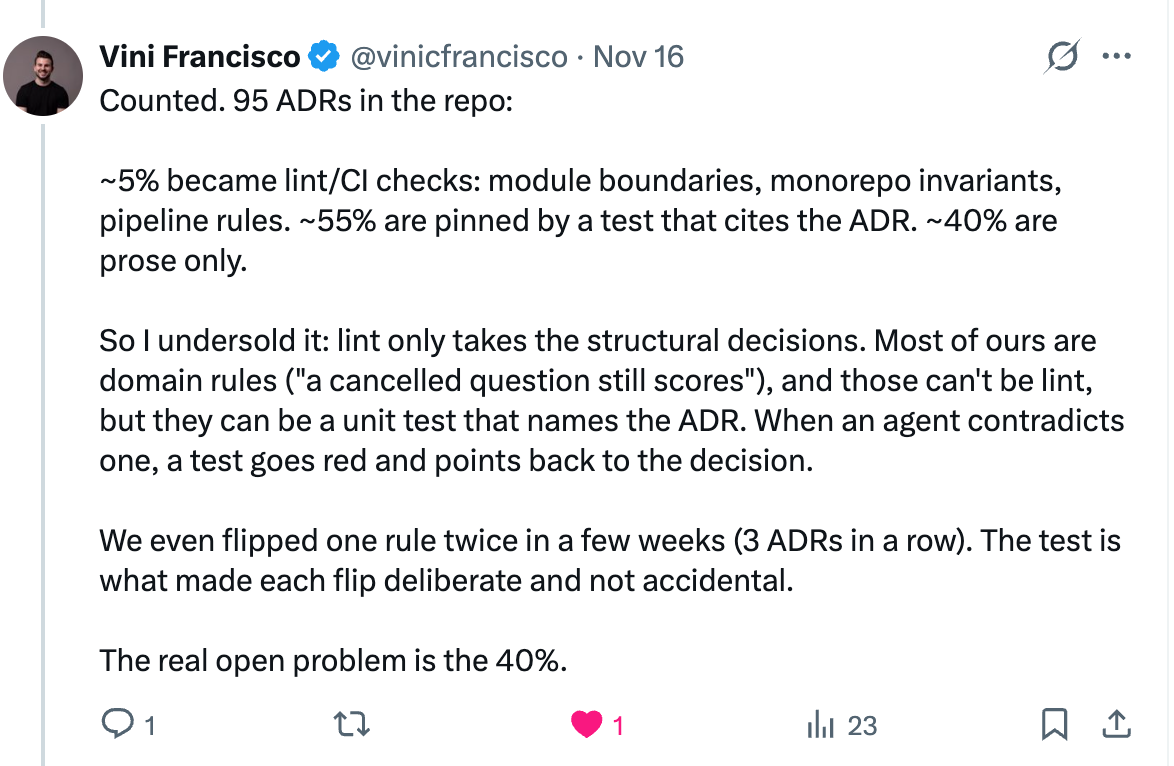
One team counted.
The pressure driving all this typing is measurable too. One CEO counted two to three pull requests per engineer per month before agents on his own repos, and about a hundred now. Human review capacity has not moved.
And one finding was universal. A decision made after an agent starts its run and before it finishes slipped through every architecture reported, without exception, including the most complete enterprise platform in the thread. The frontier of crystallization has a location, and right now it sits at that mid-flight window.
A day and a half
In that same thread I watched a protocol crystallize in public, with timestamps. An engineer told a failure story about his agents contradicting settled decisions. Another engineer pushed back on his design. They argued in replies, converged, and a day and a half after the failure story he shipped version 0.5 of his tool: a promotion gate for tentative decisions and a contradiction check wired into CI, deterministic where contradiction compiles (a negation flipped, a value changed) and advisory everywhere else. The repo is public. The argument that produced it is the best documentation it could ship with.
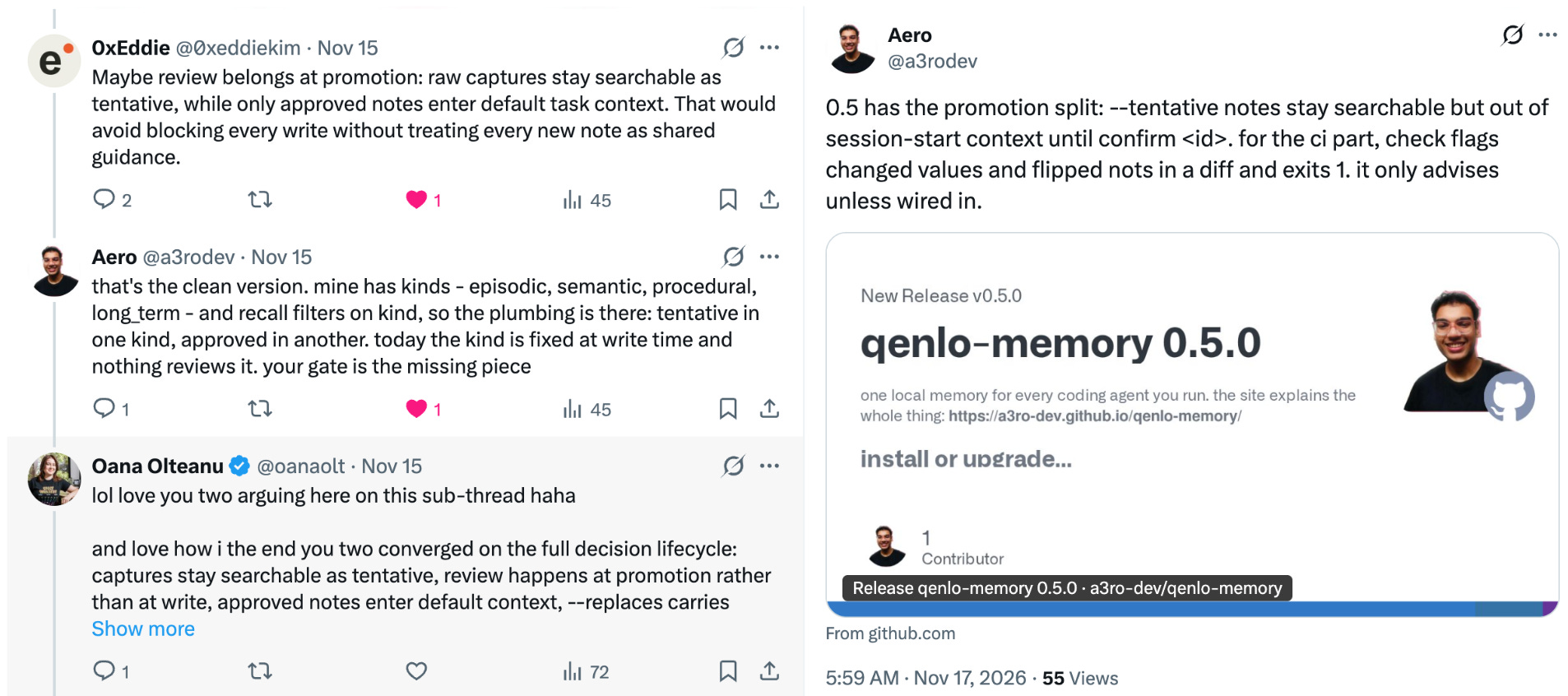
The argument, and what it shipped a day and a half later.
The Lexington’s lesson took a month to reach the Yorktown’s fuel lines. The checklist took a board of inquiry. This took a day and a half, and nobody died. That is the actual novelty of the agent era. Crystallization used to be indexed to funerals. Now it is indexed to reverted merges and burned weekends, and it runs at the speed mistakes do, which for agents is machine speed.
I have watched this clock from the investor side too. Earlier this fall a strong team pitched me a protocol layer for a pain its market had not paid for yet. Buyers were choosing workarounds over the layer, and I passed; timing was the whole reason. This month I diligenced a company selling into teams that had just started hand building their own checks, and those teams were converting to paid design partners. Same layer of the stack, opposite reception, and the only variable that moved was whether the market had paid for its mistake yet. The fossil record is a leading indicator. A protocol cannot be sold before its disaster, and you can time a category by watching where the pain was freshly paid.
The readback
So what does the readback for agents look like? I think I watched it on the flight deck.
The officer does not inspect the plane; the plane captain already did that. He does not rely on the pilot’s professionalism, though the pilot is excellent. He reads the checklist aloud, one typed item at a time, and the pilot answers each item against the aircraft in front of him, and a person who owns the launch stands there and watches it happen. Translate it. Agents that show their work as evidence rather than assurance. Checks scoped to one decision at a time, because the thread taught me that scoped checks find what stuffed reviewers miss. A human whose name is on the launch. Every element already exists somewhere in the talks and threads above. Nobody has assembled them.
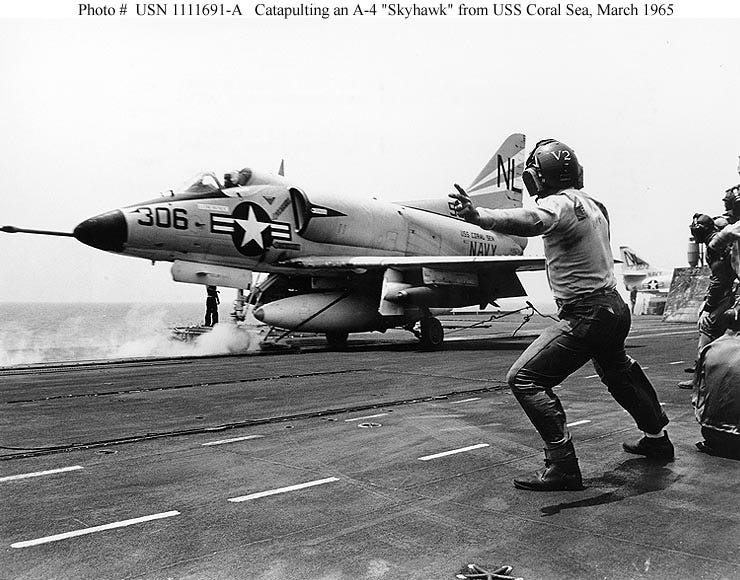
The catapult officer signals launch, March 1965, aboard USS Coral Sea, a carrier named for the battle that sank the Lexington. Official U.S. Navy photograph.
The protocols reach further than you would expect. The steam in Intrepid’s pipes was superheated, invisible when it leaked, and hot enough to cut. So crews hunted leaks by waving a broom along the pipe. Where the bristles came back sliced off, there was the leak. Even an invisible danger can be given a procedure. But not everything can. The docent told me about a refueler on night operations, pitch black on the flight deck, who finished fueling a plane, stepped back, and stopped because something felt wrong. He turned around. A spinning propeller stood an arm’s length behind him. No procedure changed afterward, because there was nothing to write down. In New York an evals engineer gave me the same answer about agents: once an incident happens, we can make sure it never happens again, but net new incidents are hard to predict. A protocol is a fossil, and fossils only record what already died.
Jorge, Talky’s cofounder, read a draft and reached for Taleb’s word for this: antifragile. You cannot write the rule for every unprecedented case, so what you want is a system that strengthens with each hit it takes. That is the fossil record’s real function. Crystallization is antifragility with receipts.
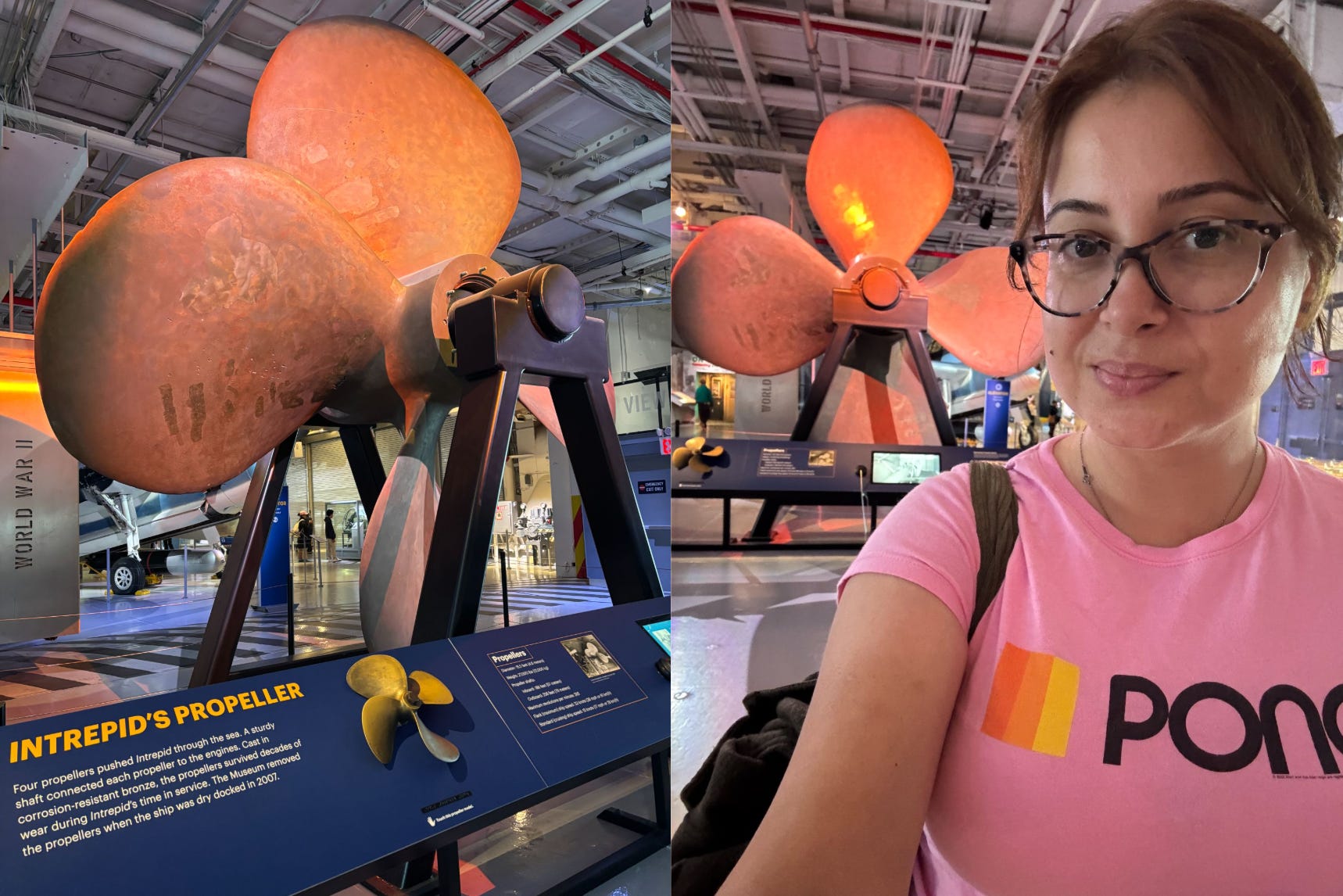
One of the four bronze propellers that drove the ship: 15.5 feet, 27,000 pounds. The one behind the refueler was an airplane’s.
The practical reading, if you build with agents: prose binds nothing, so type what can be typed, and treat every fresh incident as a rule you have not compiled yet. For founders the reading is different. The components all exist, the assembly does not, and teams began hand building this layer within the last month, which is exactly how infrastructure categories form; the builders become the buyers. Either way, watch the mid-flight window. The decision that changes while an agent runs is where the next rule is waiting to be written.
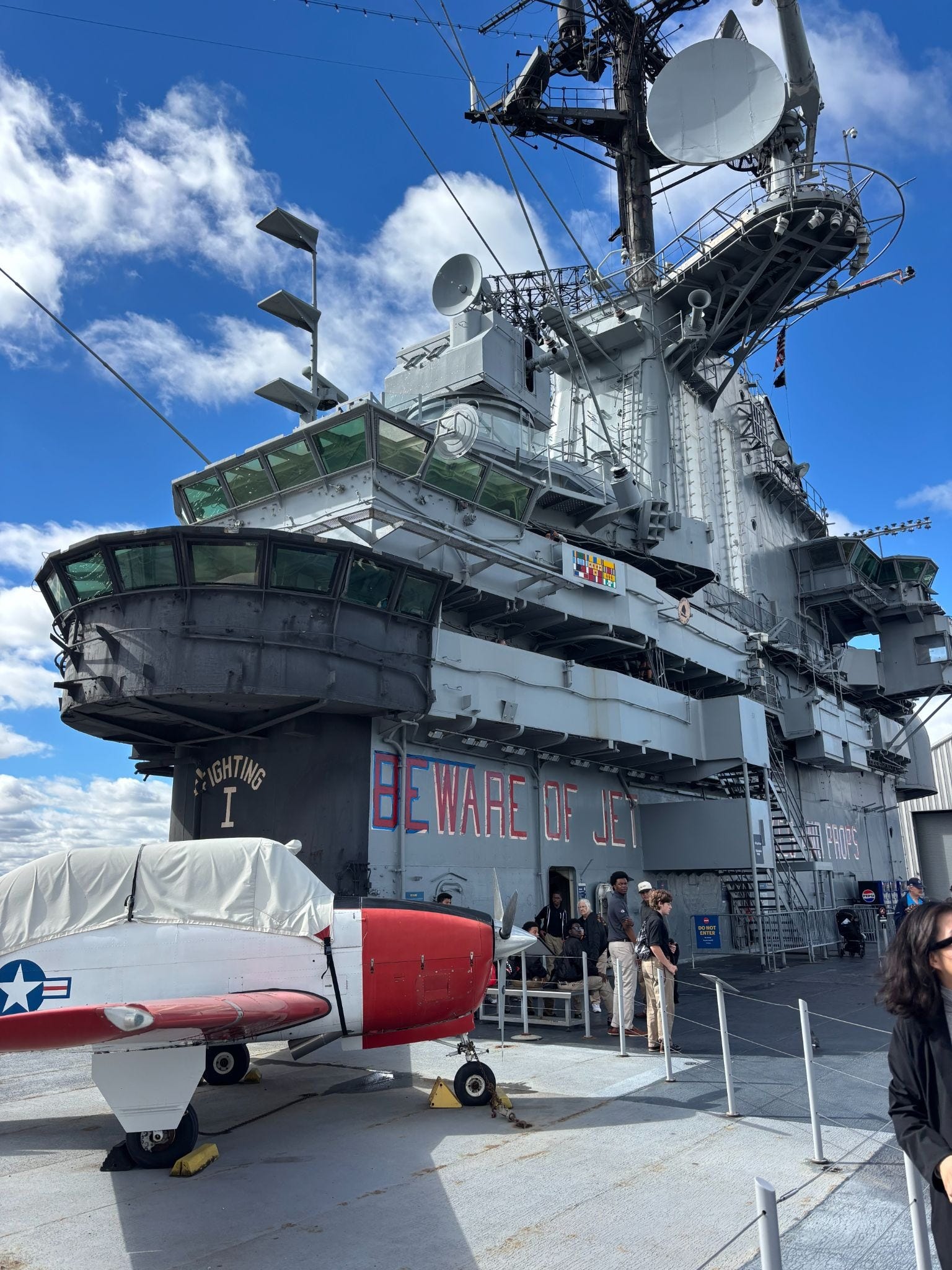
The standing warning on the island “Beware of Jet Blast and Props/Rotors”. The plane in front of you is never the only one running.
Halfway down Intrepid’s hangar deck there is a wall with the names of the men the ship lost in 31 years of service, about 250 of them. The rules that keep today’s sailors alive are indexed to that wall. The agent rulebook is being written right now, in quarters instead of decades, in public threads instead of boards of inquiry. For the first time in the history of high stakes work, the blood is optional. When you meet a protocol, read it the way a geologist reads a fossil. Something broke here. Something learned.
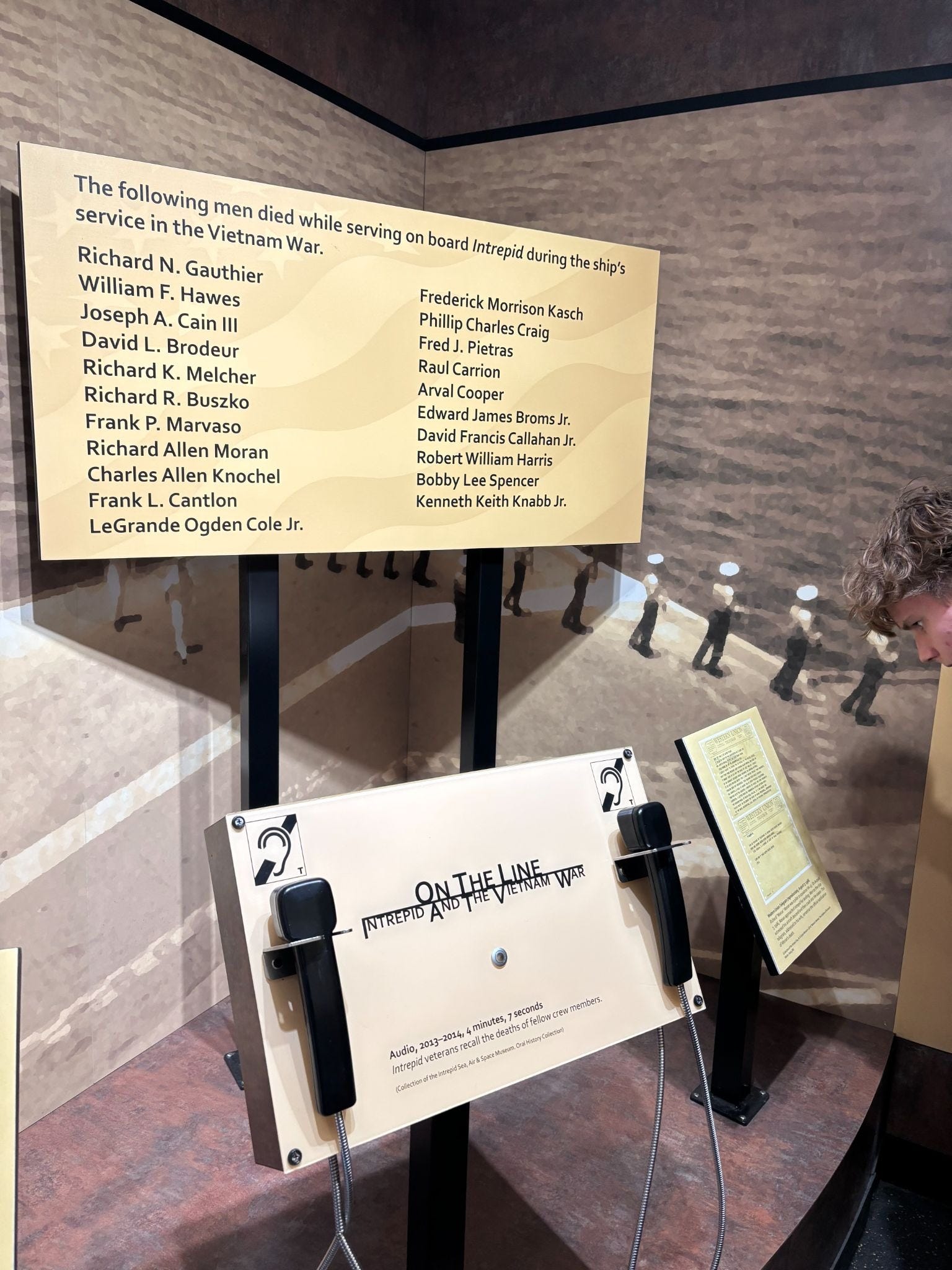
The men Intrepid lost in Vietnam, one panel of a longer list.
More essays: Accounting AI that can pass an audit, What makes 5% of AI agents work in production, AI Admissibility in Enterprise Workflow, Mapping work, not markets
You can reach me at oana@motiveforce.ai.