

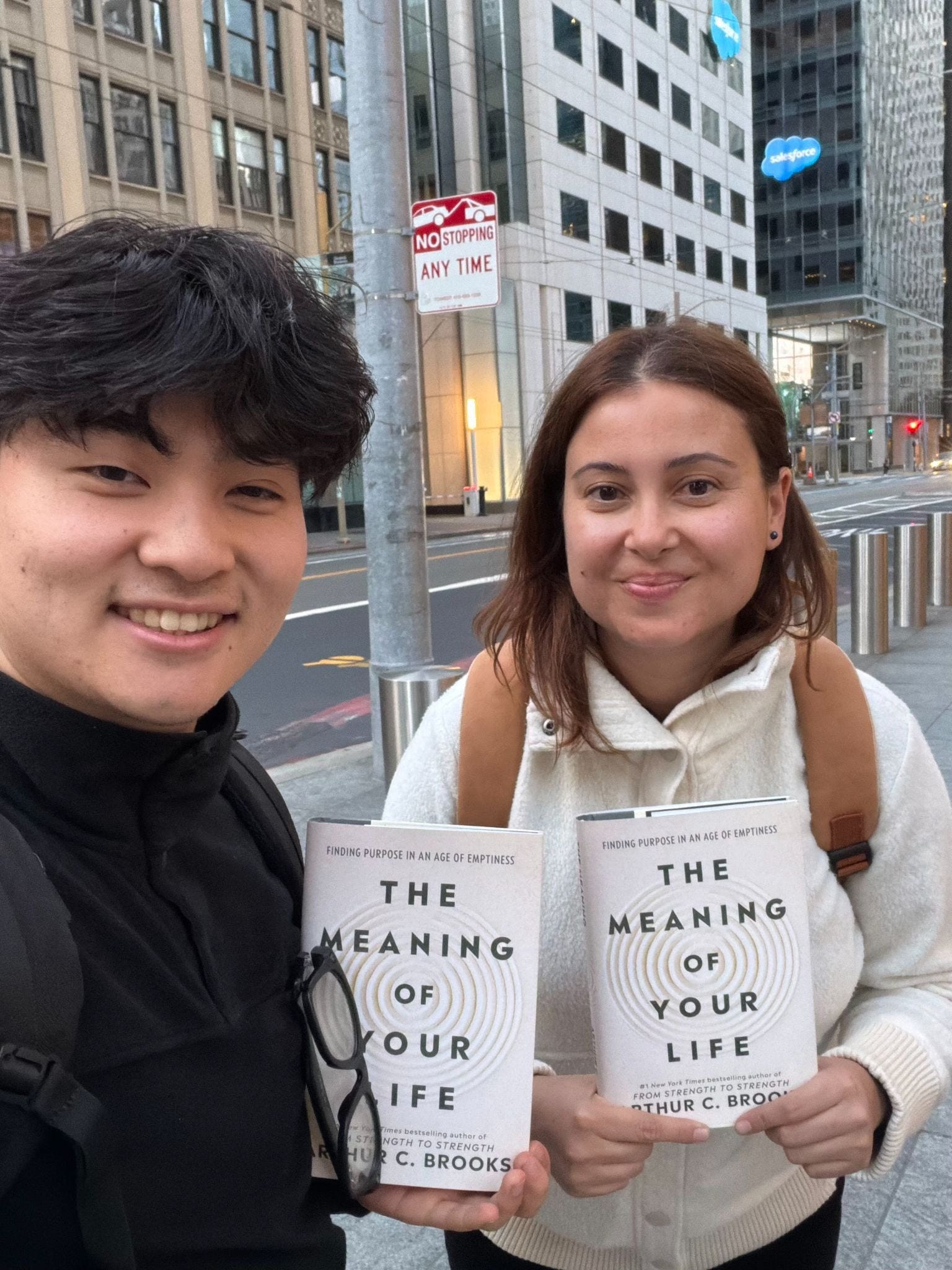
With Ryan Ni, the founder of Orca, outside Salesforce Tower.
A few weeks ago I came across a tweet that simply read: “No dating until Series B.”
Last night I heard Arthur Brooks speak about his new book, The Meaning of Your Life. I left carrying a copy and thinking about that tweet.
The juxtaposition is almost too clean. Brooks spent an hour arguing that the meaning crisis affecting young people today comes from one specific mistake: treating complex problems like complicated ones.
Complicated problems are hard but solvable. A jet engine is complicated. Scaling infrastructure is complicated. AI is complicated. Work on them long enough and they yield. Complex problems don’t yield. Marriage, grief, friendship, purpose. You don’t solve these. You live inside them. The meaning of your life is a complex problem. Love is a complex problem.
What happened after 2008, Brooks argues, is that the culture got very good at the first kind and lost its tolerance for the second. Every complicated problem now has a tool, an app, a solution. Every complex problem gets treated like a bug waiting to be fixed. The result: a generation that has optimized everything except the parts that matter.
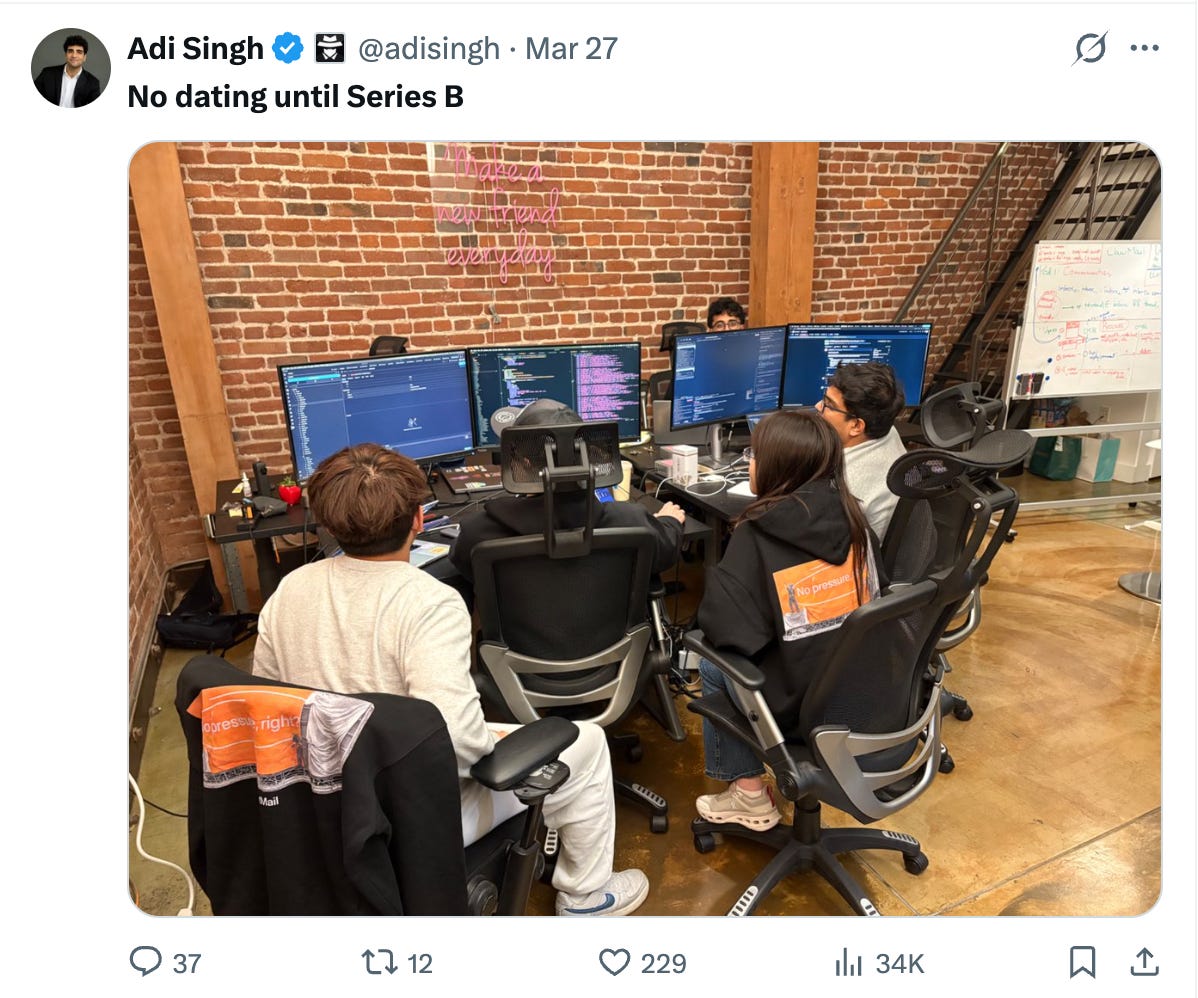
“No dating until Series B” is the startup version of this mistake. It treats love like a feature you can ship later. After the architecture is stable, after the company works. But love doesn’t queue. It doesn’t wait for product-market fit. And the longer you practice deferring it, the worse you get at the underlying skill.
Brooks made a claim that felt almost intentionally provocative in a room full of founders: falling in love may be the most entrepreneurial thing you can do.

His reasoning is exact. Founders take enormous professional risks: leave stable jobs, raise capital at long odds, spend years on outcomes with no guarantees. But many ambitious people have become radically conservative about emotional risk. Falling in love requires vulnerability, the possibility of failure, and no upside to model. It requires surrendering control in a way that no framework manages.
People in their 20s today are a third less likely to say they’re in love than people in their 20s a generation ago. Brooks told the room: if you want to prove you’re an entrepreneur, go confess your love for someone.
He told a story about a young man who heard a version of that talk and flew somewhere to tell a woman he’d been secretly in love with how he felt. She rejected him. She was already in love with someone else and introduced them. He came back to thank Brooks months later. Not because it worked. Because it was the thing he was most afraid of. And he survived it. He wasn’t afraid anymore.
That’s the point. The fear of emotional failure is just professional risk in a different category. Founders who can’t tolerate it are running on a narrower band than they think.
If you’ve already fallen
Brooks is also writing a book on staying in love, which he says generates more demand than anything else he covers. A few things he shared that are worth keeping.
Falling in love is the ignition. The goal is companionate love: deep friendship. The question to ask at the three-to-five year mark is not whether you’re still in the early passionate stage. It’s whether you’re actually friends. That’s what the data on happy couples shows.
He also argues that what makes couples last is complementarity, not sameness. Dating apps filter for sameness: shared interests, shared values, shared aesthetics. That’s mostly wrong. Difference is what holds. You can’t quantify it, which is why the algorithm keeps getting it wrong.
Two things he says every couple needs: adoration and admiration. Women, on average, need to feel adored. Men, on average, need to feel admired. The cycle runs in both directions. A lack of adoration produces a lack of admiration, which produces a lack of adoration. Most relationship failures aren’t dramatic. They’re this slow erosion. One half withdrawing, then the other following.
His advice for staying married: adore her and be admirable. What if you don’t feel it? Love isn’t a feeling, he says. It’s a commitment. The feeling is evidence of love, not the thing itself. You adore her anyway.
Brooks also said something about technology that landed differently in a room full of people building it: technology improves your life when it solves complicated problems, and degrades it when it substitutes for complex ones. Using AI to free up time and attention so you can give more of both to the people around you: good. Using it to replace those people: not good.
The founders who build things that last are not the ones who deferred everything until the company worked. They’re the ones who already knew how to commit under uncertainty, at work and everywhere else. You can’t manufacture that orientation. It either runs through everything or it doesn’t. It shows up in the product and it shows up in how you live.
That’s not a soft skill. That’s the engine.
“No dating until Series B” doesn’t describe discipline. It describes someone who has learned to optimize the left side of their brain and let the right side atrophy. You can build a company that way. You probably can’t build a life.