

A note for founders who think sleep is a luxury.
Founders track the health of their companies through numbers: revenue, growth, burn rate, runway. In startup conversations these often collapse into a single signal, the North Star metric, that tells you whether the system you are building is healthy. Marketplaces watch transactions. SaaS companies track active users. Many AI startups now focus on successful task completion: the number of times a system actually finishes the work it was designed to do.
But behind every one of those metrics sits another system that rarely gets measured: the founder.
I’m the founder of Motive Force, a pre-seed and seed investment firm, and I spend a lot of time thinking about what allows entrepreneurs to maintain clarity over long periods of uncertainty. Startups rarely rise or fall on a single dramatic moment. They compound through thousands of small decisions: hiring choices, product tradeoffs, strategic pivots, fundraising timing. The quality of those decisions matters. So does the condition of the person making them.
The founders I admire most are not just smart, they are unusually good at sustaining clarity under pressure. In my work at Motive Force, I often think about the internal energy that allows someone to do that over many years.
Over time I realized that one signal captures this surprisingly well: sleep.
The founder reality nobody likes to admit
If you talk privately with founders building companies today, especially in AI, you hear a similar story repeated in different forms. The ground is constantly moving. A technical advantage that looked meaningful a few months ago can suddenly feel fragile. Models improve, tooling changes, and entire product categories reshape themselves faster than traditional software cycles.
At the same time, the company still needs direction. Customers expect momentum. Teams need conviction. Investors expect clarity. The founder becomes the person absorbing all of these pressures simultaneously while trying to make decisions under uncertainty.
The brain does not easily shut off this mode of thinking. Pattern detection, scenario planning, and risk assessment continue running long after the laptop closes, and over time that cognitive loop becomes physiological stress that shows up most clearly at night.
For a long time I assumed poor sleep was simply the cost of building.
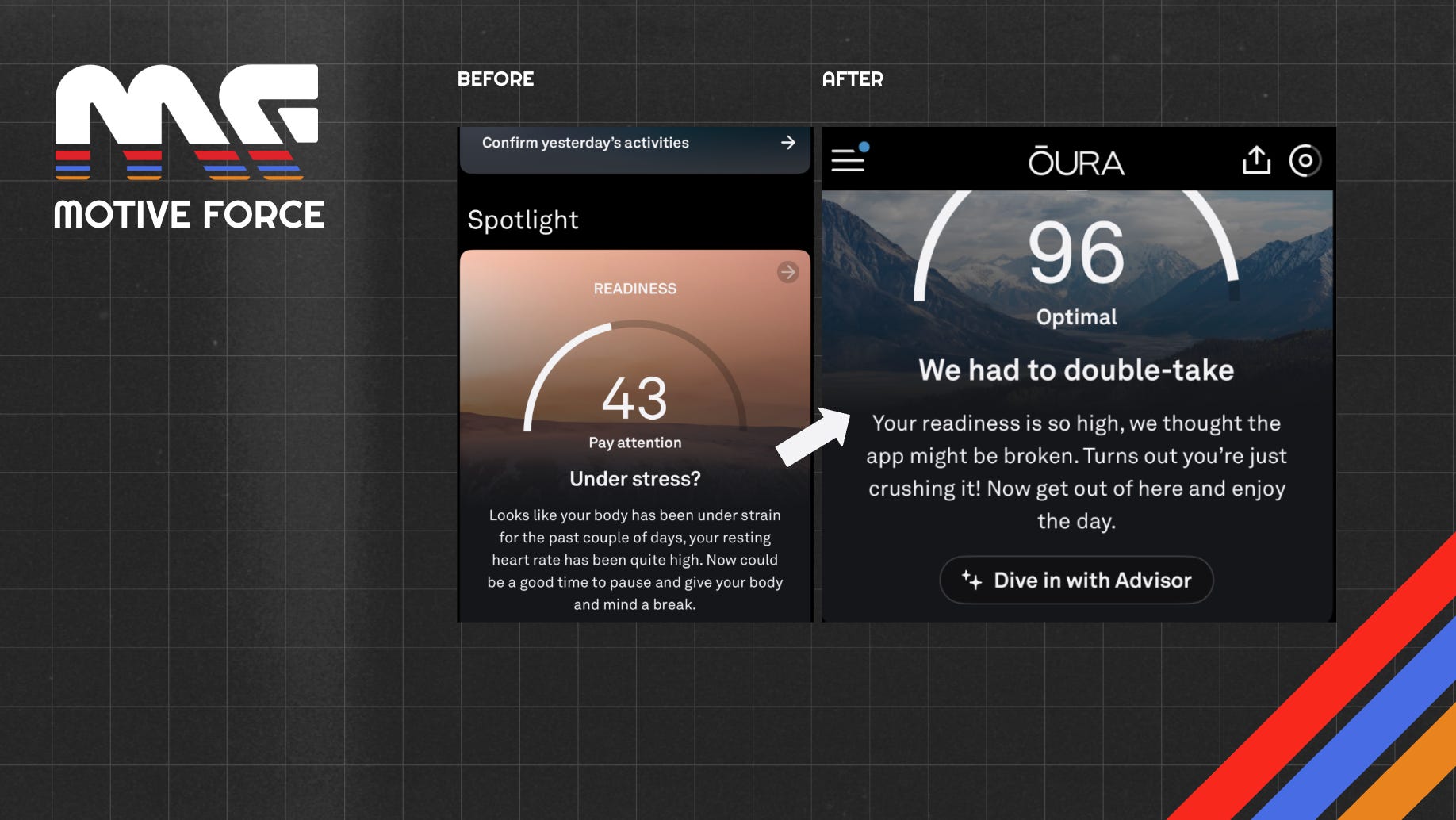
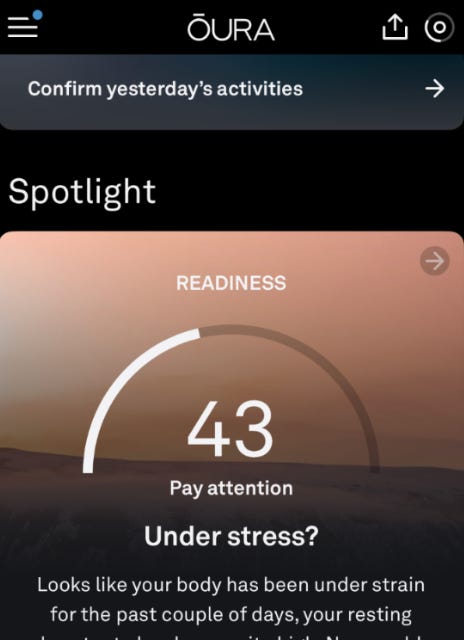
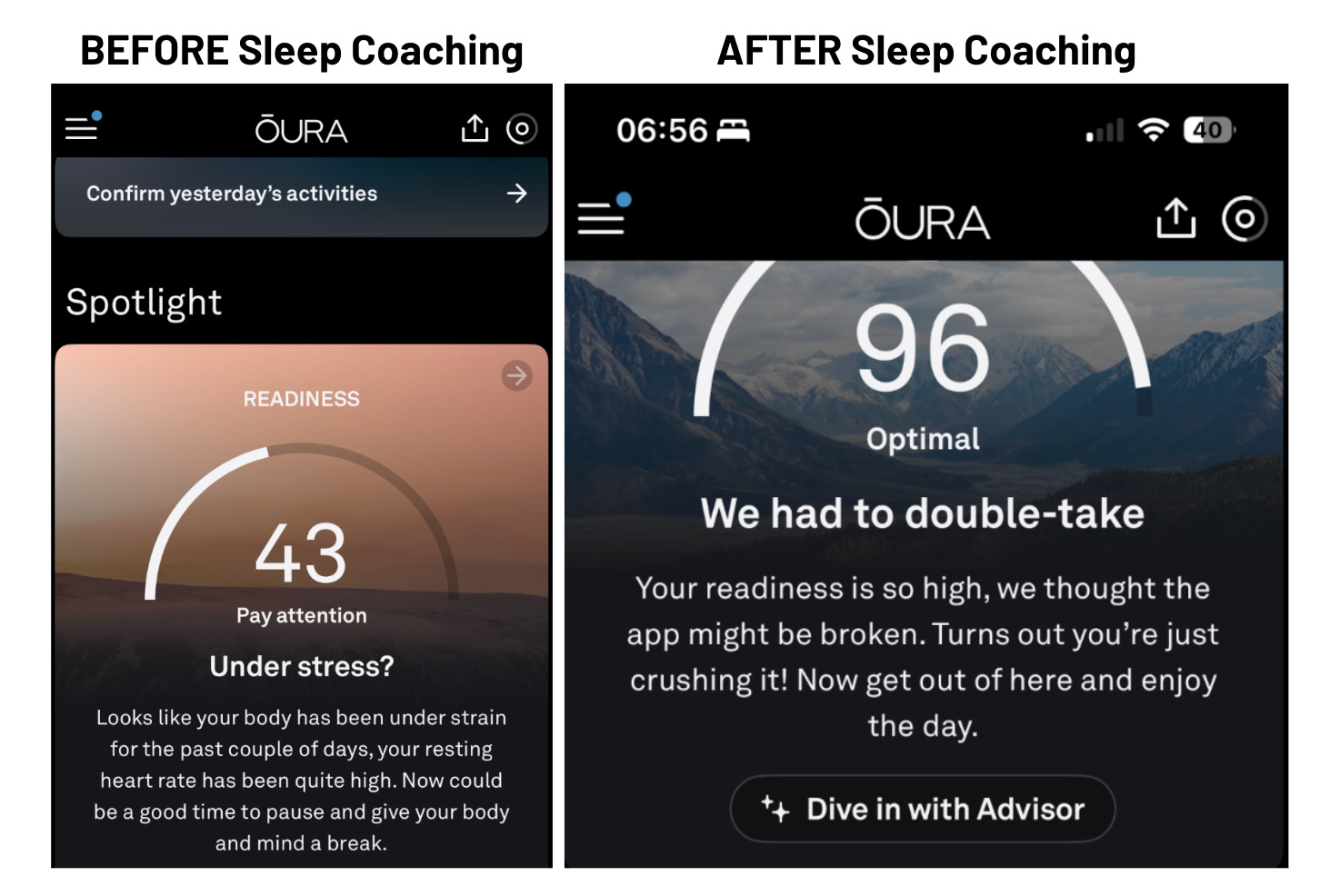
My Oura readiness scores reflected that assumption. Many days they sat in the 40s, occasionally climbing into the 50s on a good night.
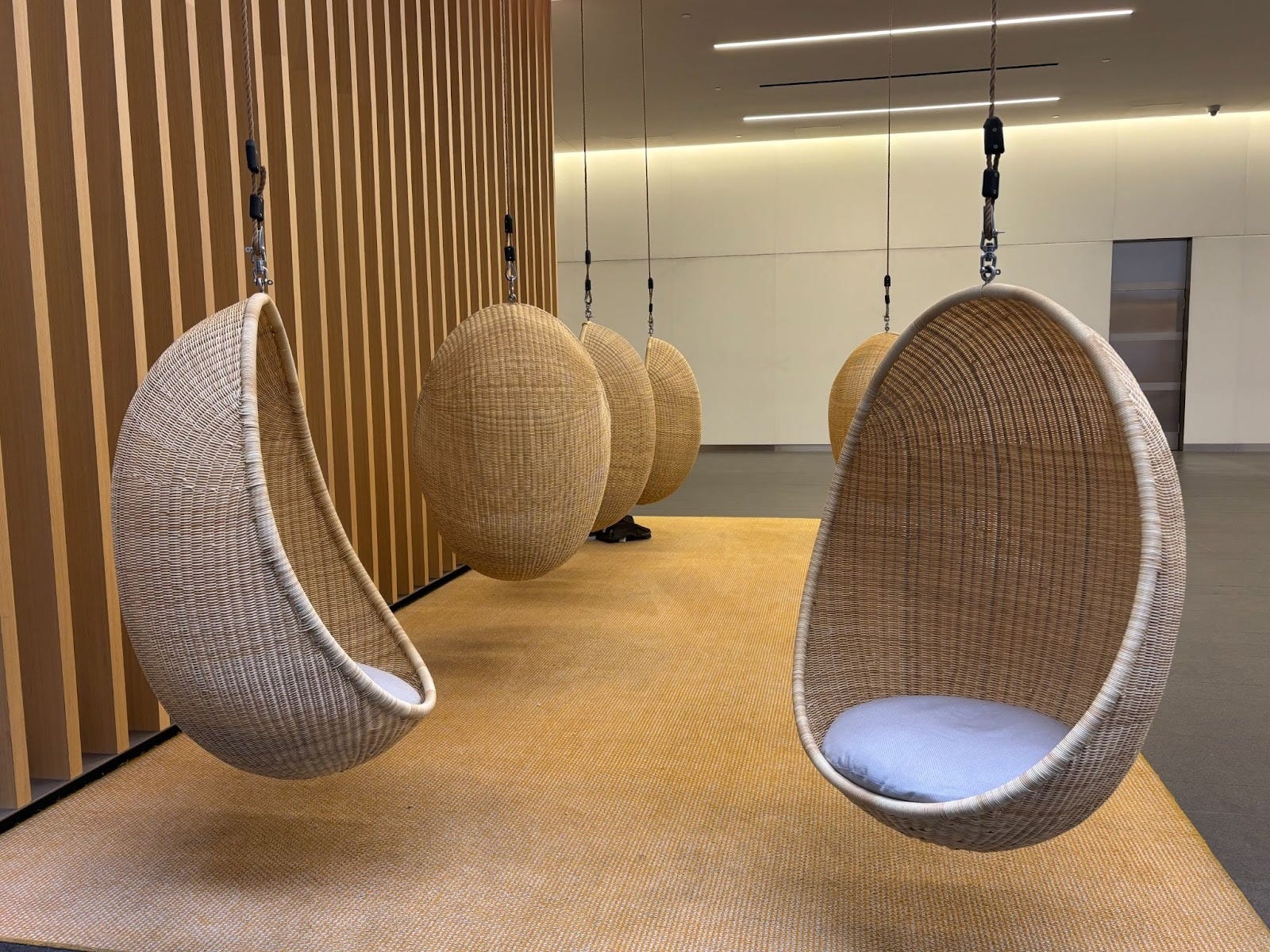
A few months ago, while waiting nervously in the lobby of an LP meeting, I noticed a set of egg-shaped hanging chairs and sat in one to calm my nerves. By coincidence, Lee, who would later become my sleep coach, was sitting nearby with her husband.
She handed me her card. That is how the conversation started.
When I began working with her, I expected the usual advice that circulates in productivity culture: drink tea, avoid screens, maybe meditate before bed. Instead, her approach to sleep looked strikingly similar to how strong founders approach systems.
She did not treat sleep as a checklist of habits. She treated it as the outcome of interacting variables: stress load, physiology, light exposure, behavior, and recovery cycles. Sleep quality, in her view, emerges from how those variables interact over time.
Within a few weeks something happened that I had never seen before. My readiness score crossed 90. The Oura app literally said, “We had to double-take.”
But the number itself was not the most interesting part. What mattered was how my mind felt the next day: calmer, less reactive, and more capable of holding complex problems without immediately tipping into stress.
That experience forced me to rethink the role sleep plays in founder decision making.
Why this matters for founders
Sleep does not replace judgment or experience. It shapes the state from which judgment operates.
It affects emotional regulation, patience, cognitive stamina, and the ability to sit with uncertainty without reacting impulsively. For founders, those qualities matter enormously. Building a company requires sustained decision making under ambiguity, and the internal operating state of the founder shapes how those decisions are made.
The shift for me was moving from seeing sleep as recovery to seeing it as decision infrastructure. Nothing about the external environment changed, markets were still uncertain, fundraising was still ambiguous, companies were still hard to build. What changed was my ability to navigate those conditions with clarity.
That difference compounds over time.
Turning sleep into something observable
One of the simplest suggestions from my coach was to start tracking a few signals daily. The tracker was intentionally simple: sleep score, readiness score, stress exposure, and short notes about the day.
After a few weeks patterns began to appear.
Sunlight and walking had a stronger effect on sleep quality than I expected. Late-night cognitive work, especially unresolved problem solving, tended to linger in the body longer than I realized. And perhaps most surprisingly, the effects were often delayed. A stressful day on Tuesday might show up as poor sleep two days later.
The tracker did not solve the problem by itself. What it did was make the system visible. Once patterns appeared, behavior started adjusting naturally.

Sleep as founder infrastructure
The deeper lesson in all of this is that sleep is not indulgence.
It is infrastructure.
Founders are comfortable investing in systems that improve company performance: better tools, faster feedback loops, stronger hiring, tighter processes. Yet we rarely think of the human system producing decisions with the same seriousness.
But the same logic applies. When the system producing your clarity degrades, everything downstream eventually degrades with it.
Sleep does not guarantee good decisions. It does something more subtle and more important: it stabilizes the conditions under which good decisions become possible.
A thought for founders
Most founders already track the metrics that describe the health of their companies. Those numbers matter.
But if the system producing your clarity and judgment begins to break down, the company will eventually feel it too.
That is why I have started to think of sleep as a founder metric, not because it guarantees wisdom, but because it shapes the state from which founders make decisions.
For people trying to build through uncertainty over many years, that state matters.
Acknowledgment
I would not have discovered this without my sleep coach. She approaches sleep with the kind of systems thinking I admire in founders: looking at how physiology, stress, behavior, and recovery interact over time instead of offering generic advice.
If sleep has been a struggle for you, I genuinely recommend speaking with her:
https://allrested.com - filled in a form for 10min before the first free session, and then I got to change my sleep in two months, price can be negotiated. It’s super easy.
She is doing the kind of work that quietly improves people’s lives, and I’m grateful I had the chance to work with her.