

This week Nvidia reportedly agreed to pay $12.9 billion for it. When the news broke, I went back through my messages with Clem. The first one is from August 2019.
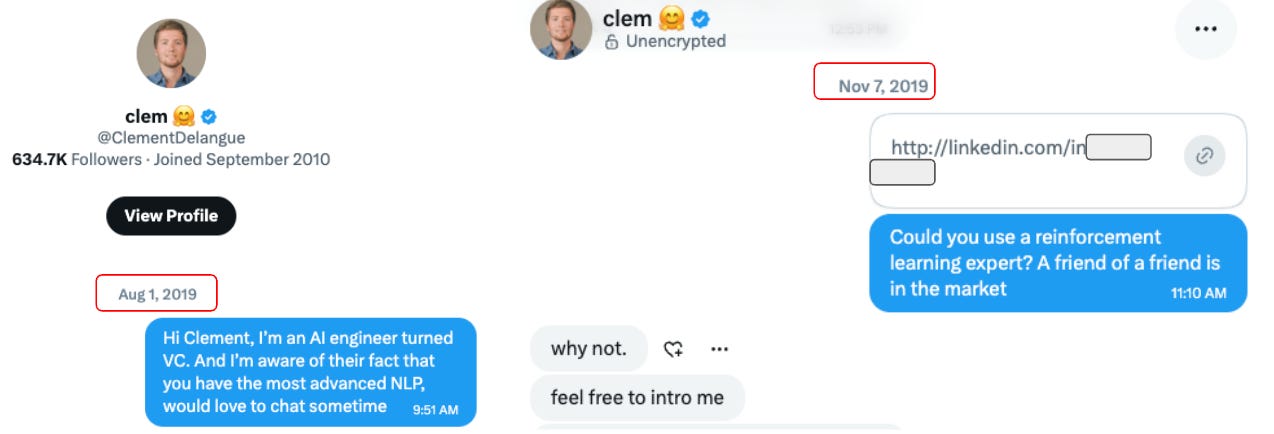
I had been in venture for about a year. Before that I was an ML engineer. I cold messaged Clem because Hugging Face looked interesting. I told him I was new to venture and thought of myself as more of an engineer than a VC, which was and still is true.
He told me he wasn’t taking VC meetings.
Fair. Three months later I messaged him again, this time because I knew a reinforcement learning engineer looking for his next thing. He replied in five minutes with his email. We kept in touch. In 2022 he invited me to a Hugging Face happy hour, we sat down and talked properly, and Clem asked if I’d consider joining Hugging Face.
I didn’t. But I went home and kept thinking about the company, and I did what I tend to do when something won’t leave me alone: I looked at the data. I wanted to map who was actually building on them and why the engineers I knew wouldn’t shut up about the product. So I started going through every piece of public adoption data I could find on their GitHub and told Clem I’d send it over with my notes. He replied:

I keep coming back to that sentence.
The original Hugging Face insight was almost embarrassingly simple. Machine learning research code is a mess. Not because researchers are bad engineers. The incentives are different. The code needs to work once, produce the result, beat the benchmark, get the paper accepted. Then everyone moves on. You could try to make all of that code clean. Or you could accept the chaos and put a clean interface on top of it.
Hugging Face did the second thing. Transformers made models written by different people, in different frameworks, for different purposes, feel like things you could pick up and use.
At the time, this created an awkward investment question: who pays for the framework? It was a good question. In 2019 the answer wasn’t obvious, and anyone who says otherwise is remembering backwards.
But something happens when enough people use the same doorway. They start leaving things there. Models. Then datasets. Evaluations. Applications. Eventually the doorway becomes a place. By 2022 the activity had moved from GitHub to hf.co. The thing I was measuring had migrated.
In hindsight there was a better question to ask in 2019. If this becomes the default doorway, what accumulates around it?
Today Hugging Face is where a large part of the open AI world publishes, discovers, and downloads models, and Nvidia is reportedly willing to pay $12.9 billion for a company doing roughly $150 million in revenue. Whether the revenue justifies the price is the boring question. The interesting one is what else is there. The distribution. The developer graph. The models, and the people who put them there. Even the worry in this week’s coverage gives it away: analysts keep asking whether Hugging Face’s neutrality can survive Nvidia. Nobody worries about the neutrality of a Python library. You worry about the neutrality of infrastructure.
There’s a principle in here that I keep returning to in other companies. Don’t eliminate the mess. Find the boundary where the mess becomes inevitable, and make that boundary legible. Hugging Face did it for research code. Weights & Biases did something adjacent for experiments. Inngest, a company I invested in, does it for execution that fails, retries, and spans time. I’ve come to call this Beautiful Software: software whose abstraction tells the truth about the system underneath it.
I didn’t have this language in 2019. But I had boots on the ground. I watched Hugging Face spread through my geek friends: one enthusiastic engineer, then another, then everyone. I watched the same thing happen with Weights & Biases.
If you’re building one of these thin interfaces at a layer where the mess is inevitable, you might not have revenue for years. To anyone who doesn’t use the product, you’ll look irresponsible, or dead.
I couldn’t have told you in 2019 that Hugging Face would be acquired for a lot of money. Nobody can. But conviction doesn’t need a prediction. Conviction is what you’re doing when there’s nothing yet to gain. It’s staying around a founder who told you no, sending him engineers, and going through his public adoption data at night because the question won’t leave you alone. I did all of that for one reason: I was convinced something was accumulating at that doorway.
I’m long open source. I’ve invested in a lot of it, sometimes alongside people from Hugging Face. When Explosion, the company behind spaCy, returned to its roots in 2024, Hugging Face gave them $250,000 to keep the open-source work going. Clem personally invested in Hyperparam, one of my portfolio companies.
The team lives the culture. You can see it in where they put their time and their money.
I think that’s part of what I was seeing seven years ago, before I had a name for it. Not the outcome. The accumulation.
That’s what I look for at Motive Force: the strange thing, before the outcome makes it obvious.
Interesting concept: doorway becoming a place
Do you have more examples of the thin layer above chaos? Is Github / Gitlab basically the OG version of this concept?