

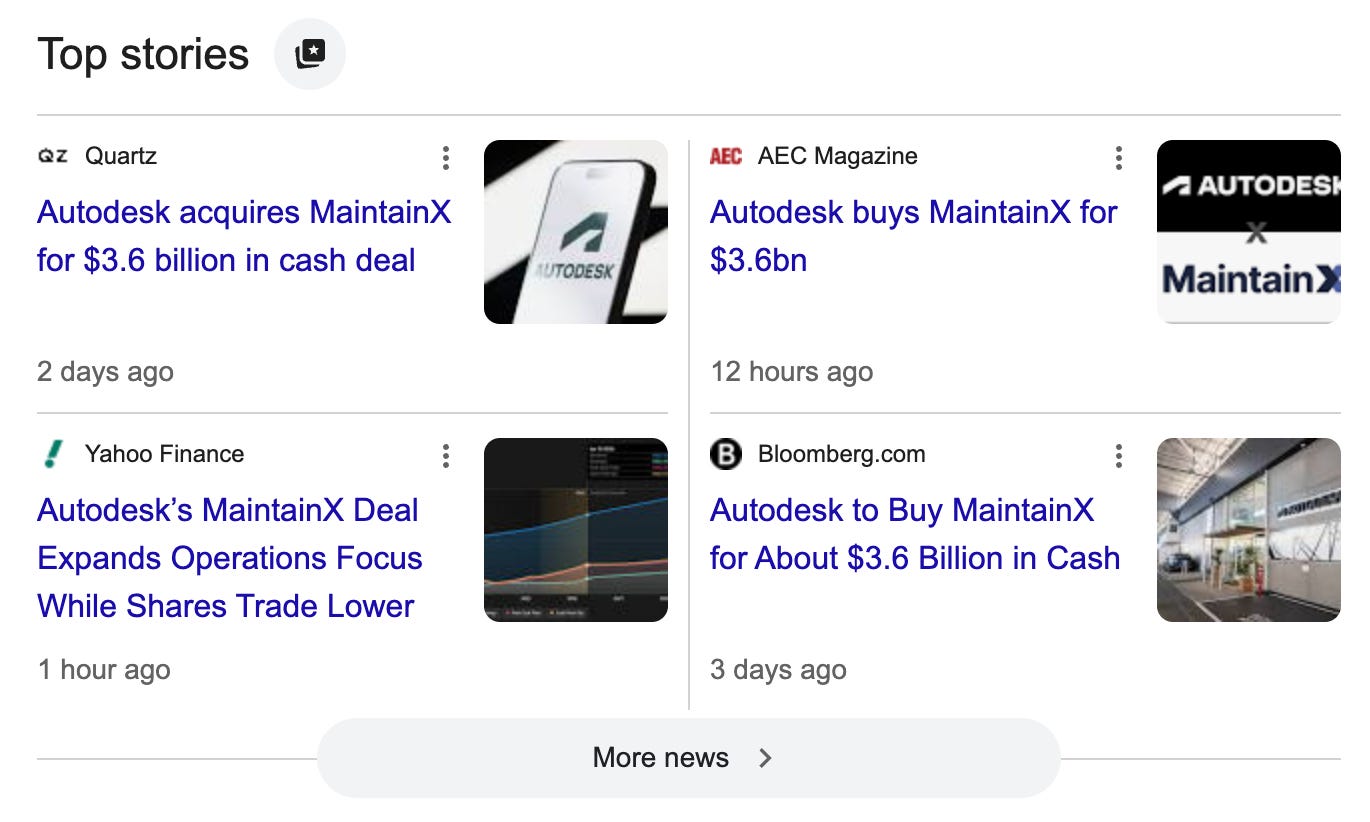
How I found out
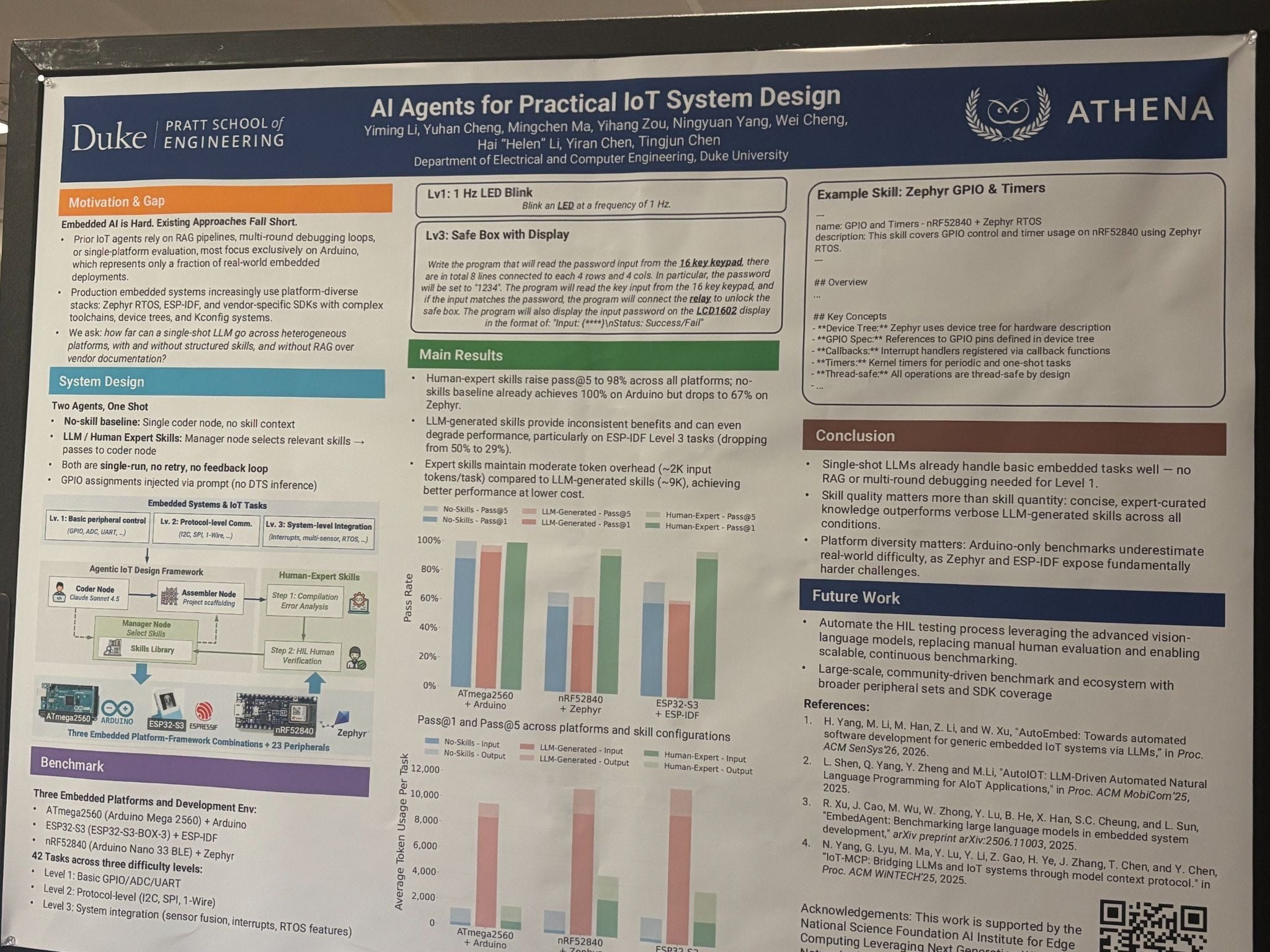
I got the news that Autodesk is acquiring MaintainX for $3.6 billion while I was at the ACM Conference on Agentic Systems, standing in front of a Duke research poster on using AI agents to design IoT systems for physical hardware. Another VC texted me "you made some good money?" and I thought it was a funny VC way of asking how I was doing, only to find out he was referring to the acquisition.
MaintainX was the first angel check I ever wrote. I wrote it when the company was early, operating in a category most investors found unappealing, raising against real skepticism about whether the market was worth building in. The company just sold for $3.6 billion. The reasons I invested are the same reasons that later became the foundation of my new firm, Motive Force.
When the announcement landed, my first reaction was joy for the employees and for Chris the CEO, because I knew how much he prioritized the people around him. Then came the confirmation that the pattern I had believed in before I founded Motive Force was real. Then, of course, the financial outcome. This essay is about the pattern, not the multiple. It is written for the founders who are building something that looks like MaintainX looked then: important, under the radar, and underestimated.
Why legacy workflows baffle traditional pattern recognition
There is a type of software company that rarely generates excitement in a partner meeting. Not because the problem is small, but because nothing about it triggers mainstream venture pattern recognition. Maintenance software is one of those categories.
Say the word maintenance and people picture a clipboard, a technician in a hard hat. Software for developers and consumers is easier to imagine becoming a venture-scale business. It walks straight past the worker trying to figure out why a concrete mixer stopped spinning.
Maintenance doesn’t look like a trendy tech market. It operates in the background, an invisible layer of daily work that simply keeps factories running and supply chains moving.
The subtler miss is the forcing function. Why would a maintenance manager buy this today? The value lives entirely in absences: downtime that never happened, audits that went smoothly, equipment that kept running. Without standing inside those workflows, the urgency never lands.
The software looks optional. And optional software raises an obvious question: feature or company? SAP already had asset management and maintenance orders. Existing vendors served the space.
Market size, competitive positioning, and product differentiation are easy to see from a pitch deck. The gap between what a legacy system covers and what the person on the floor actually needs is much harder to see.
That gap is where MaintainX lived. You cannot see it from a market map. My advantage was that I wasn’t starting with the market. I was starting with the workflow.
The defensibility of the last mile
Before venture, I spent years at SAP mapping business process ontologies, tracing exactly how data moves across 25 industries and how work actually happens on the ground. That work taught me to view software not as a product category but as a position inside a workflow.
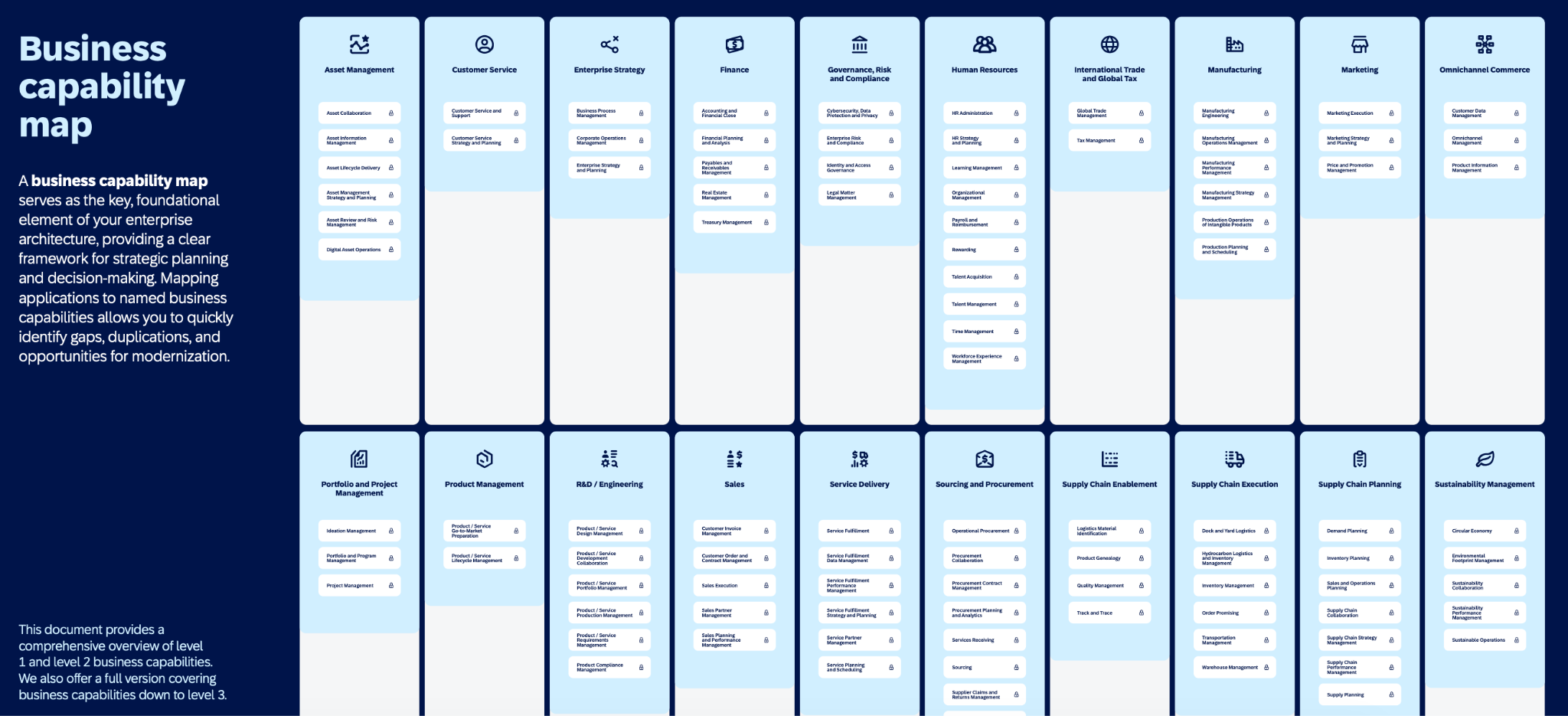
Look at enterprise asset management. Legacy giants like SAP understand the architecture. The data models are correct and the integrations exist. What a legacy ERP cannot reach is the technician standing in front of a broken machine.
MaintainX started at that terminal point and worked backward. It captured clean data at the moment of execution and fed it back into the broader ERP web. The enterprise system of record stayed in place. MaintainX became the system of action in front of it. When Duracell, a Fortune 500 company with a full SAP environment, deployed MaintainX between its technicians and its ERP, it was because that operational gap was real and the legacy system wasn’t going to close it.
This pattern goes beyond industrial maintenance. Anywhere an enterprise system of record exists, there is a last mile where the software runs out of reach, where a person has to make a decision or execute a task the system was never designed to support. That is where defensible software companies get built. The incumbent cannot go there. The person doing the work finds the tool that does, adopts it without being asked, and refuses to give it up. The last mile argument explains why MaintainX was defensible. It does not fully explain why it won.
Beautiful Software: when complexity disappears
The founding team started from a simple observation: 80% of the global workforce is deskless and less than 1% of software investment goes toward them. The device infrastructure had finally arrived. Smartphones in every pocket, cameras front and back, data costs collapsed. The missing piece was software that treated frontline workers as the primary user, not as an afterthought.
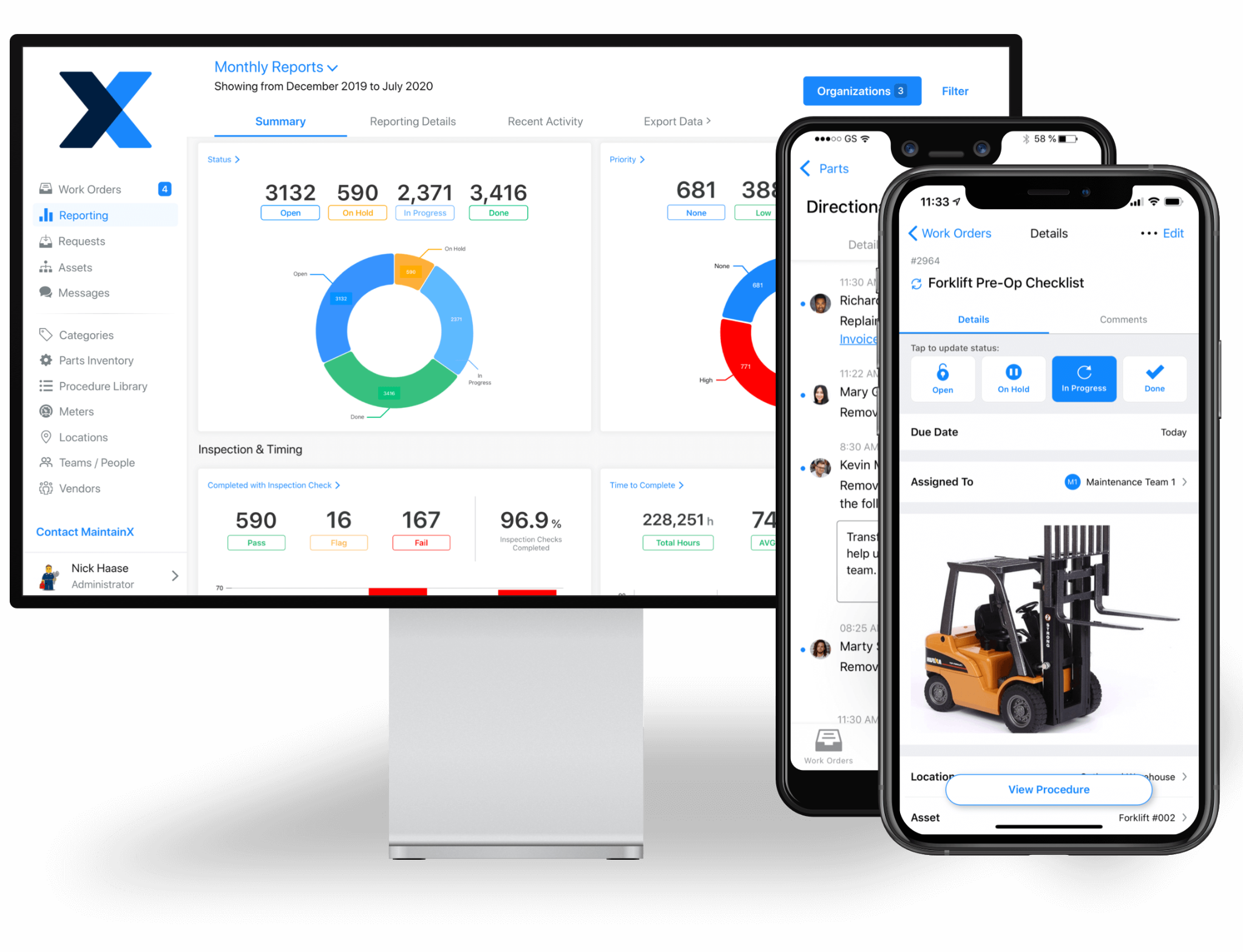
They built a mobile-first system with the sensibility of a consumer app. You could learn it without training. You could use it offline. You could attach photos, add notes, document completion with a timestamp, all from the floor on the device already in your pocket.
But the insight that mattered most was not the interface. It was the choice of where to begin.
MaintainX anchored on the work order, the unit of responsibility in maintenance work: create it, assign it, execute it, document it, close it. From that single entry point everything else followed. Preventive maintenance is a recurring work order. An inspection is a structured work order. A parts request flows out of a work order. The product grew by following the work, not a roadmap.
This is what I mean by Beautiful Software. Not beautiful as decoration. Beautiful when code architecture mirrors user intent so cleanly that complexity disappears. When every interaction feels inevitable rather than engineered. MaintainX did not simplify maintenance. It absorbed it. Offline mode for facilities where connectivity dies mid-shift. QR-coded assets so a new technician can pull up the full service history of a machine they have never touched. Conditional procedures that branch based on what the inspection actually finds. Parts depletion that updates inventory the moment a work order closes.
None of this is glamorous. All of it is the actual work.
When it worked, customers noticed in ways that are hard to fake. A manager at ColdTrack: “Our procedures are now attached 100% to the work order. Every step of the way, you need to take a picture. MaintainX documents everything we need, and I can literally watch the timestamps.” A manager at AEL: “All I have to do is put a MaintainX report on the big screen in the conference room and it just makes sense to everyone there.”
The person who owns the budget for this software is the same person who gets called at midnight when the line goes down. The ROI is not abstract. It lives in the difference between having a record of every inspection an asset has ever had and thinking someone wrote it down somewhere.
When software earns its place in that relationship, between the person who owns the outcome and the work that produces it, it becomes hard to remove. Not because of a contract. Because the institutional knowledge lives there now.
What care looks like at scale
Even as MaintainX became the category leader, the team kept operating like the work was still unfinished. When enterprise customers needed SAP integration, they built it correctly rather than minimally. When AI became the inflection point for the industry, they moved toward it with intention: AI-generated procedures, predictive maintenance, reporting tools that turn a decade of execution data into operational intelligence. They were thinking about giving every technician an expert colleague before most competitors had noticed the question arriving.
The founder treated frontline workers as first-class citizens of the product, not as users to be digitized. In practice that means something specific. The product is designed around the reality of their work, not the convenience of the software’s architecture. Offline mode actually works. A new technician can be productive in an hour. The report that comes out of the system is clear to the person standing in the conference room, not just to the analyst who built it.
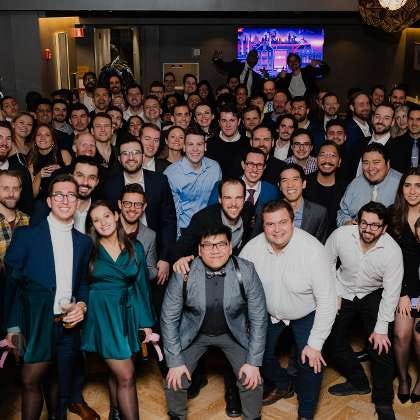
That same care extended to his team. Doing right by them through every financing round, through the exit, through hiring the best people, through jumping on AI early rather than defending what already worked. You cannot build beautiful software if you do not care about the people building it with you. Chris understood that. It shows in the product and it shows in how he ran the company.
Autodesk is acquiring MaintainX because Autodesk builds the tools to design and make physical assets, and MaintainX owns the data layer for what happens to those assets once they exist in the world. Design without feedback from operations is half a loop. The acquisition closes it. Not just a better maintenance app. The operating layer through which the people who keep the physical world running actually do their work.
For the founders reading this
I started Motive Force after seeing patterns like this one. People often ask whether I invest in developer tools, AI infrastructure, enterprise software, or operational software. The answer is yes. Because those are categories. I start somewhere else. I do not look at market maps. I decompose work.
My background is unusual for a VC. Computer science and machine learning on one side. Years at the world’s largest enterprise software company, spanning 25 industries and 11 lines of business on the other. Most investors are trained to get excited about hot markets. My time at SAP trained me to have a taste for the opposite: the workflows that don’t make conference panels, the software that sits inside real operations, the founders who understand the work at the level of individual tasks and handoffs rather than market maps and logo slides.
I trace how a process flows from initiation to completion, where responsibility is held, where execution happens, where the enterprise system runs out of reach and someone is still solving the problem with a clipboard. That lens applies equally to a dev tools company and a maintenance software company. What I am looking for in both is the founder who understands the work so well that the product feels inevitable.
The customers were right about MaintainX before the market was. If you're building one of these companies, I'd love to hear from you.
Oana Olteanu is the founder and GP of Motive Force, an early-stage venture firm investing in Beautiful Software at pre-seed and seed.
oana@motiveforce.ai
Great sharing!!! Awesome investment!!!
awesome!