

I spent the last few weeks collecting compensation data from AI engineers because multiple founders kept asking me the same question: “What the hell do I pay an AI engineer?”
They’d check Pave, their VCs’ platform subscriptions, the usual comp databases. All useless. The data is stale, generic, and doesn’t capture what’s actually happening in the AI talent war right now.
So I did what any reasonable person would do: I asked AI engineers directly. 50 of them shared real numbers, anonymously, across different stages, geographies, and experience levels.
This isn’t statistically rigorous research. Some buckets have just 3-4 responses. But it’s actual data from actual engineers in the market right now, and even with small samples, the patterns are unmistakable.
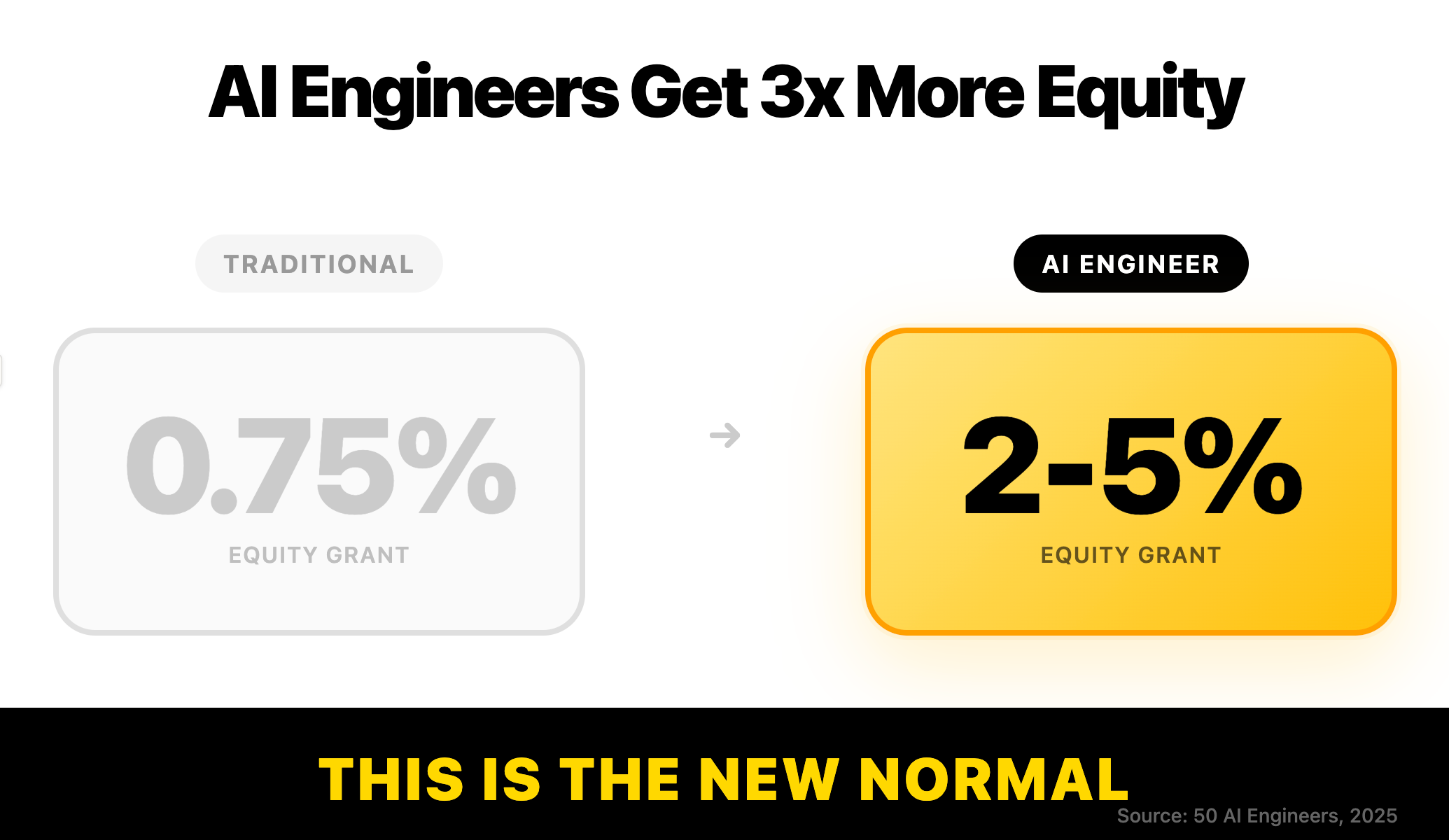
The headline finding? AI engineers at seed stage are getting 2-5% equity. That’s not a typo.
For context, the traditional playbook says to give your first technical hire around 0.75% equity. Senior engineers at seed typically max out at 1-1.5%.
AI engineers are commanding 3x that. And after seeing this data, I think they’re still underpriced.
The Numbers That Matter
I’m showing you exactly what I collected. Think of these as data points from the field, not a comprehensive study. With 3-7 people in most buckets, I’m showing you ranges and what was most common, not percentiles.
US Compensation by Stage
Pre-seed/Seed (US)

That senior number isn’t a mistake. The 7 senior seed-stage AI engineers who shared data are all making $240-275k base. Most at $250k. At seed. When the company has maybe 10 people and $3M in the bank.
Series A/B (US)

Interestingly, Series A/B compensation actually compresses. The desperation premium at seed disappears once companies have more resources and options.
Later Stage (US)

The Europe Reality Check
If you’re a US founder thinking “I’ll just hire in Europe,” here’s your wake-up call:

Yes, you can hire a mid-level AI engineer in Europe for $50-85k. The same person costs $175k in the US. This 3x gap is why every SF startup has a “stealth European AI team.” But there’s a reason the best European AI talent ends up working remotely for US companies at US rates.
The Equity Story Is Even Crazier
This is where things get genuinely wild. Traditional wisdom says your first engineering hire gets 0.5-1% equity. Maybe 1.5% if they’re exceptional and you’re desperate.
Here’s what the 8 seed-stage AI engineers who shared equity data actually got:
Equity at Pre-seed/Seed (8 responses)

Most common: ~2% High end: 5%+
I had to triple-check these numbers. Half these engineers are getting 2% or more. For context, 5% is what you’d traditionally give a co-founder who joined three months after incorporation. Now it’s the going rate for a senior AI engineer who can actually build your product.
My take: They’re worth it. If you’re building an AI company and your competitive advantage is the AI, then your AI engineer IS a co-founder, whether you call them that or not.
What AI Engineers Actually Think About Their Comp
The anonymous comments were more revealing than the numbers:
“Small companies are often toxic.” Translation: That 5% equity comes with 80-hour weeks and a CEO who Slacks at 2am.
“People lowball offers because they claim they’re helping you get into AI...they say it’s a favor so they can justify paying less.” This is apparently widespread. If someone tells you they’re “doing you a favor” by letting you work on their AI startup, run.
“I work as much as 3 employees would do in a regular company.” The dirty secret of AI engineering: you’re not hiring an engineer, you’re hiring an entire technical team. They’re doing ML infrastructure, data pipelines, model training, deployment, and often product thinking too.
“I got in around 2022-2023 and pay has become depressed since then. I got lucky but it is hard to hit this number now.” Some engineers are sitting on packages that would be impossible to get today. The market has rationalized somewhat from the 2022 peak, but it’s still wild by traditional standards.
“It does not match the work I do. I work as much as 3 employees would do in a regular company.” The scope creep is real. You start as an “AI engineer” and end up owning everything from data pipelines to product strategy.
So What Does This Mean?
For Founders:
1. Recalibrate your equity budget immediately. If you’re planning to hire AI engineers with a traditional 10% employee equity pool, you’re already dead. Your first two AI hires might eat 5-8% alone. Plan accordingly.
2. The $250k seed-stage senior is the new normal. Stop trying to hire senior AI talent for $150k. They have five other offers at $250k+. Either pay market or hire junior and train (if you have time, which you don’t).
3. Geography arbitrage works, but barely. Yes, you can hire in Europe for 1/3 the cost. But the best European engineers know their worth and work remotely for US companies anyway. You’re fishing in an increasingly small pond.
4. “AI Engineer” spans a huge range. Someone fine-tuning models is different from someone building training infrastructure from scratch. The person who can do both commands the high end of these ranges.
For Engineers:
1. You’re probably underpaid. Based on this data, if you’re a senior AI engineer in the US making less than $200k, you’re at the bottom of the range. Time to have a conversation.
2. Equity expectations have shifted dramatically. Don’t let anyone tell you that 0.5% is “generous” for an early AI hire. The data shows 2% is common, 5% is achievable.
3. The burden is real. Those high packages come with expectations of doing 3x the work. Make sure you’re being compensated for the actual scope, not just the title.
The Uncomfortable Truth
Here’s what nobody wants to say out loud: AI engineers aren’t just expensive because they’re scarce. They’re expensive because right now, the difference between having real AI capability and having a wrapper around GPT is the entire ball game.
If you’re a founder building an AI company, your AI engineers aren’t employees. They’re co-founders you’re paying a salary. Price them accordingly.
If you’re an AI engineer, you’re not just writing code. You’re the entire technical strategy. Price yourself accordingly.
The market is telling us something important: in the age of AI, technical talent isn’t just an input to the business. It IS the business.
Traditional engineering equity at seed: 0.75-1% AI engineering equity at seed: 2-5%
That’s not inflation. That’s the market recognizing reality.
Questions for readers: Is this matching what you’re seeing? What did I miss? And for those of you who’ve been in the market recently: what other dynamics are at play that the numbers don’t capture?
Thanks to the 50 engineers who shared their data.
More essays: How to Think Like a VC When Evaluating a Startup Role, What Makes 5% of AI Agents Actually Work in Production, Semantic layers, Fine Tuning, Founder Mental Software, Normalizing the Founder Journey, AI Engineer World’s Fair 2025 - Field Notes
Great insights, love your qualitative research approach!